

A photograph shows an insect, fibre, plastic fragment or unidentified particle near a bag of creatine. The immediate reaction may be to blame the powder, the factory or the shipment.
But the photograph rarely answers the most important question:
Where was the material actually found?
Foreign matter mixed into the powder is a different event from material found between two liners, inside an unopened outer carton or on the exterior of a drum. All deserve investigation, but they do not provide the same evidence about product contact or contamination origin.
FDA describes extraneous material broadly as foreign matter associated with objectionable conditions or practices during production, storage or distribution. That definition is useful because it prevents an investigation from stopping at the factory door—or beginning with an unsupported conclusion.
Establish the Exact Location Before Discussing the Cause
The complaint record should identify whether the material was found:
- • inside the creatine powder;
- • against the product-contact surface of the primary liner;
- • between two polyethylene liners;
- • between the liner and outer bag or drum;
- • inside the shipping carton;
- • on a pallet or external packaging surface;
- • after the package had already been opened.
This distinction matters. Material between two intact liners may indicate a packaging or handling problem, but it does not automatically prove contact with the creatine. Conversely, foreign matter recovered directly from the powder requires a more extensive product-safety assessment.
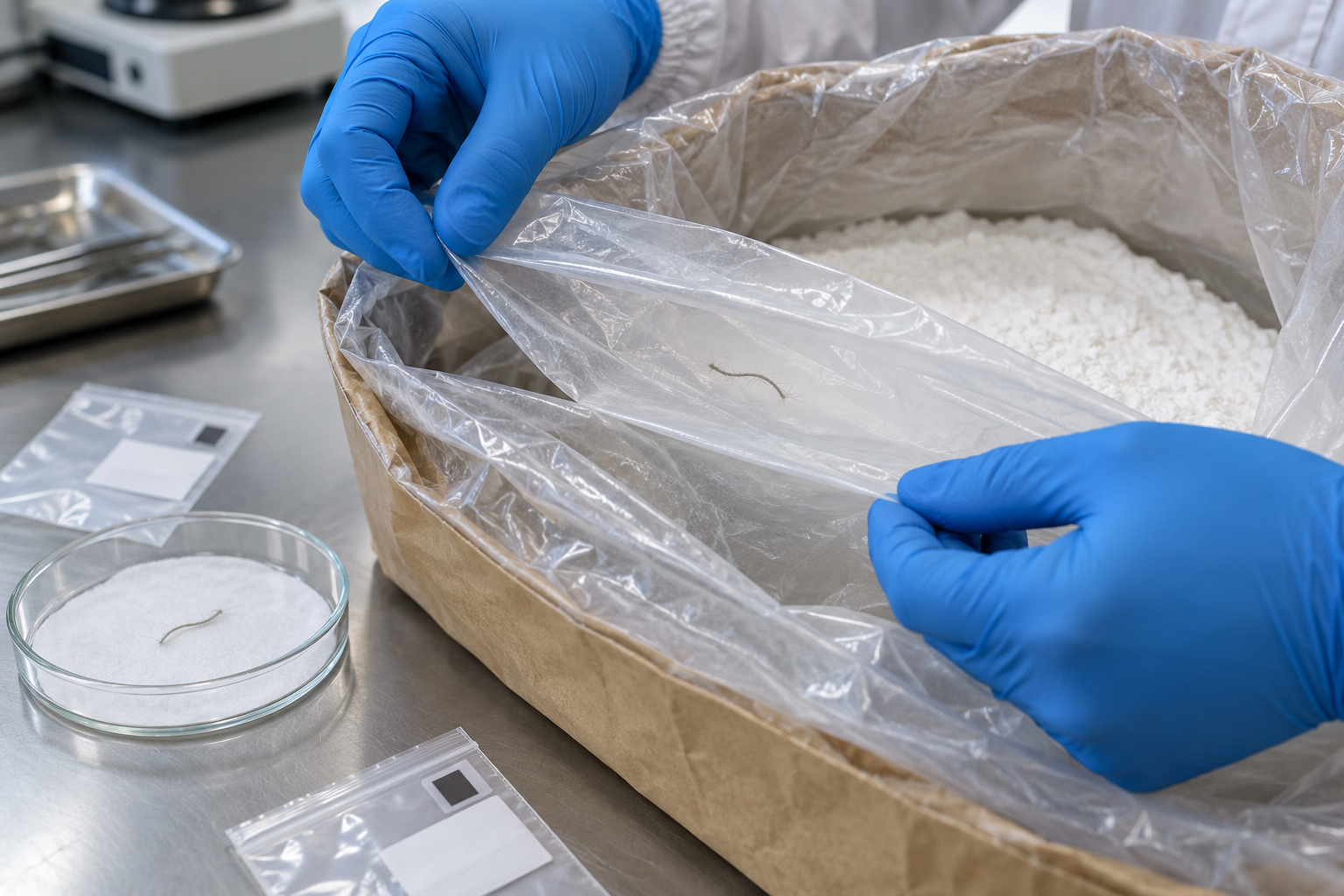
Photographs should show the object’s original position, surrounding packaging, seals, labels and lot information before anything is moved.
Preserve the Evidence Instead of Cleaning It Away
The affected container should be quarantined and protected from further handling. Do not discard the object, empty the bag or transfer the remaining powder into another container.
Record:
- [ ] product name, grade and lot number;
- [ ] bag, drum, pallet and shipment identification;
- [ ] whether every seal was intact;
- [ ] when and where the package was opened;
- [ ] who discovered the material;
- [ ] storage conditions after receipt;
- [ ] photographs before and after opening;
- [ ] whether other containers show similar findings.
If multiple bags are involved, record each one separately. Combining observations into a general statement such as “the shipment contained insects” can make it impossible to determine how many containers were affected or where the material was located.
Inspect Unopened Containers From the Same Lot
The next step is not automatically to open every bag. Select unopened containers under an agreed investigation plan and examine their labels, seals, liner condition and external surfaces.
The inspection should determine whether the event appears:
- isolated to one package;
- concentrated on one pallet or shipment area;
- repeated across multiple containers;
- associated with damaged seals or packaging;
- limited to external or non-product-contact surfaces.
A retained sample can help evaluate the powder, but it cannot reproduce everything that happened to the commercial package during storage and transport.
Trace the Possible Entry Points
A credible investigation follows the material through the complete chain:
- raw-material production and screening;
- filling and liner-closing operations;
- packaging-material storage;
- finished-goods warehousing;
- container loading and export;
- transport and destination storage;
- opening and sampling at the customer’s facility.
Records may include line-clearance checks, sieve or magnet controls, packaging inspection, pest-control activity, cleaning records, warehouse observations, loading photographs and shipment history.

Identification Can Help—But It Has Limits
Where practical, the foreign object may be examined by a qualified laboratory or specialist. Identification can distinguish an insect from plant matter, packaging debris or another particle and may narrow the possible environment of origin.
However, identification alone may not prove when or where the material entered the package. A species associated with warehouses, for example, could have been introduced during packaging storage, transport or destination warehousing.
“No evidence found” is also not equivalent to proof that an event could not have occurred.
Make a Risk-Based Lot Decision
The final decision should consider the object’s identity, location, likelihood of product contact, package integrity, recurrence across the lot and intended use of the ingredient.
- • releasing unaffected containers
- • placing lot on hold
- • additional inspection/testing
- • rejecting affected units
- • extending review to adjacent lots
- • implementing CAPA
EU food law requires traceability through production, processing and distribution, while food-hygiene rules place responsibility on food businesses to prevent contamination. These principles support a documented investigation but do not create one universal disposition for every foreign-material complaint.
How SRS Supports a Creatine Complaint Investigation
SRS Nutrition Express can help assemble the commercial-lot COA, specification, batch traceability, packaging information, available filling and inspection records, shipment documentation and retained or representative samples.
Send the original photographs, exact discovery location, lot and bag numbers, seal condition, storage history and number of affected containers. These details are more useful than a cropped image of the object alone.
SRS can support the investigation and coordinate information with the manufacturer. The customer’s responsible quality team retains authority for the final risk assessment and lot disposition.
Evidence Boundaries
- [!] A photograph alone usually cannot establish the source of foreign material.
- [!] Material found between packaging layers is not equivalent to material mixed into the powder.
- [!] One affected package does not prove that every container is affected.
- [!] A compliant retained sample does not automatically invalidate evidence from the commercial package.
- [!] Final disposition must consider applicable regulations, product use and the company’s approved quality procedures.
Recommended Reading
- How to Investigate an Out-of-Specification Creatine Result
- How to Sample Creatine Monohydrate From Multiple Bags or Drums
- Changing Creatine Suppliers? A Qualification Checklist Before Your First Commercial Order
References
- U.S. Food and Drug Administration. Filth and Extraneous Materials Program.
- Electronic Code of Federal Regulations. 21 CFR Part 111—Current Good Manufacturing Practice for Dietary Supplements.
- Electronic Code of Federal Regulations. 21 CFR §111.155—Requirements Applying to Components of Dietary Supplements.
- Electronic Code of Federal Regulations. 21 CFR Part 117—Current Good Manufacturing Practice and Risk-Based Preventive Controls for Human Food.
- European Parliament and Council. Regulation (EC) No 178/2002—General Food Law.
- European Parliament and Council. Regulation (EC) No 852/2004 on the Hygiene of Foodstuffs.
Post time: Oct-29-2026


