

Creatine gummies solve a real consumer problem: they remove the scoop, shaker and daily mixing routine. But convenience only creates value when the finished serving continues to deliver its declared dose.
In June 2026, Brazil’s National Health Surveillance Agency, ANVISA, suspended the sale, distribution, advertising and consumption of three lots of green-grape-flavoured creatine gummies. The manufacturer had initiated a voluntary recall after creatine content was found outside the established limits. ANVISA also reported labelling and manufacturer-information irregularities.
The notice did not identify the technical cause of the failed creatine results. It does, however, highlight the need to connect raw-material selection, formulation, testing and stability before commercial launch.
1 Start With a Creatine Grade That Fits the Project
Creatine monohydrate powder is highly stable when kept dry under suitable storage conditions. Once incorporated into a gummy, it enters a system containing water, acids, sweeteners, flavours and a gelling agent.
Raw-material approval should therefore consider more than assay alone. Before the first trial, the formulation team should confirm:
- • creatine monohydrate identity and assay basis
- • creatinine, DCD and DHT limits
- • moisture or loss on drying
- • particle-size distribution
- • density and handling behaviour
- • batch COA and representative sample availability
Particle size may affect dispersion and process handling, but a finer grade does not automatically solve every gummy-formulation problem. The proposed material still needs to be tested in the actual gelling system and process.
SRS Nutrition Express can provide grade-specific specifications, representative COAs and creatine samples so the formulator and OEM can compare suitable options before committing to commercial volume.
2 Build the Dose Before Building the Gummy
The development brief should define the intended declaration before the gummy size, flavour system and packaging are fixed.
Important questions include:
- Is the target stated as creatine monohydrate or creatine equivalent?
- How many gummies make one serving?
- How much creatine must each gummy contain?
- What manufacturing tolerance will be applied?
- How will process loss be investigated?
- Can the intended dose fit without compromising texture or consumer acceptance?
Creatine monohydrate is approximately 88% creatine by molecular weight. A declaration based on creatine equivalent is therefore not numerically identical to one based on creatine monohydrate.
SRS can help review the raw-material calculation against the proposed serving claim. Any additional input intended to compensate for manufacturing or stability loss should be justified by pilot and stability data rather than applied as an arbitrary overage.
3 Follow the Dose Through the Production Process
A compliant raw-material COA does not establish the creatine content of the finished gummy. The validation plan should follow the ingredient through the stages where the result could change:
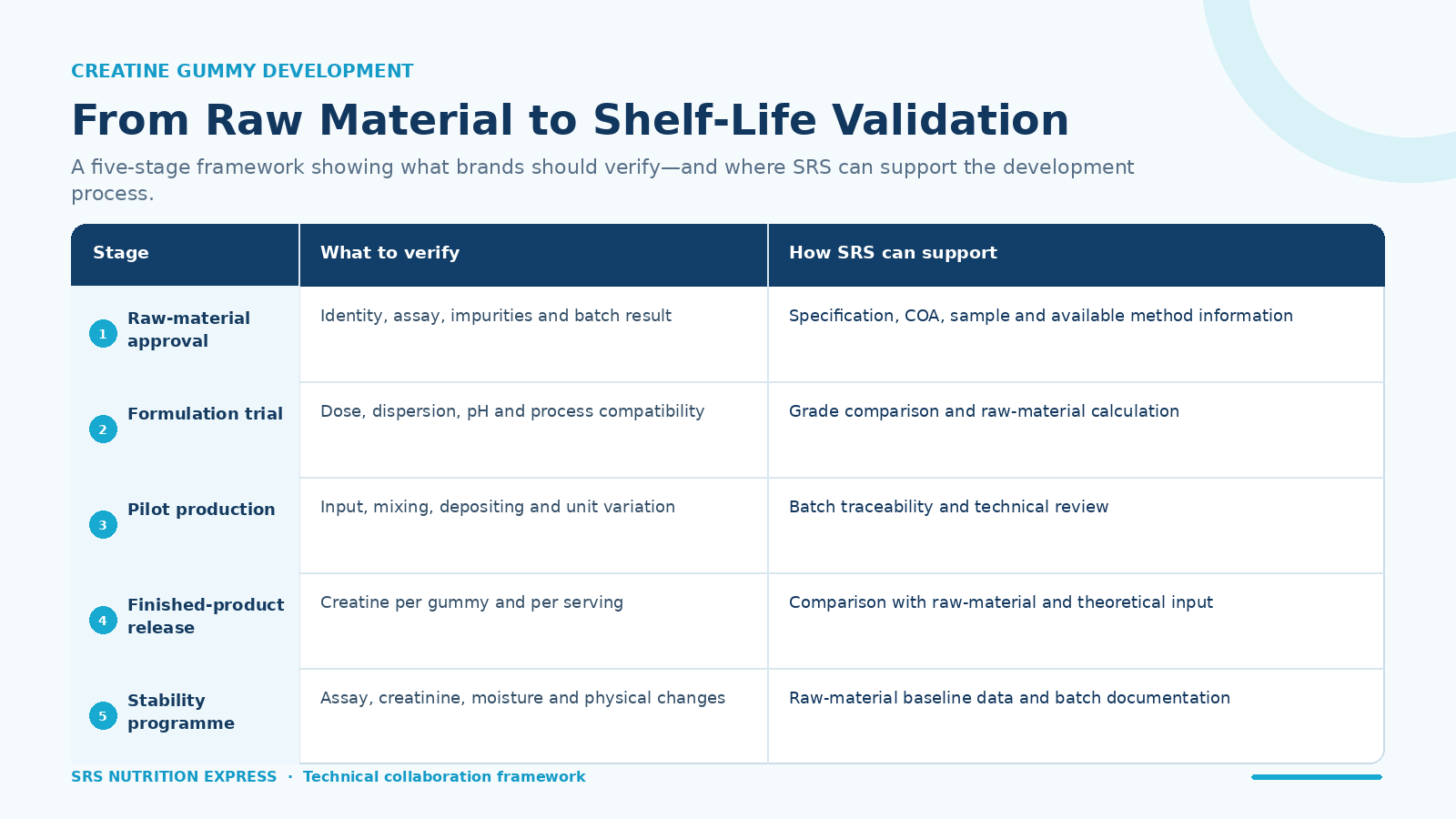
Samples should represent the beginning, middle and end of production where appropriate. Testing only one convenient gummy provides limited evidence about batch uniformity. The responsible manufacturer and quality team remain responsible for approving the sampling plan, analytical method and final lot decision.
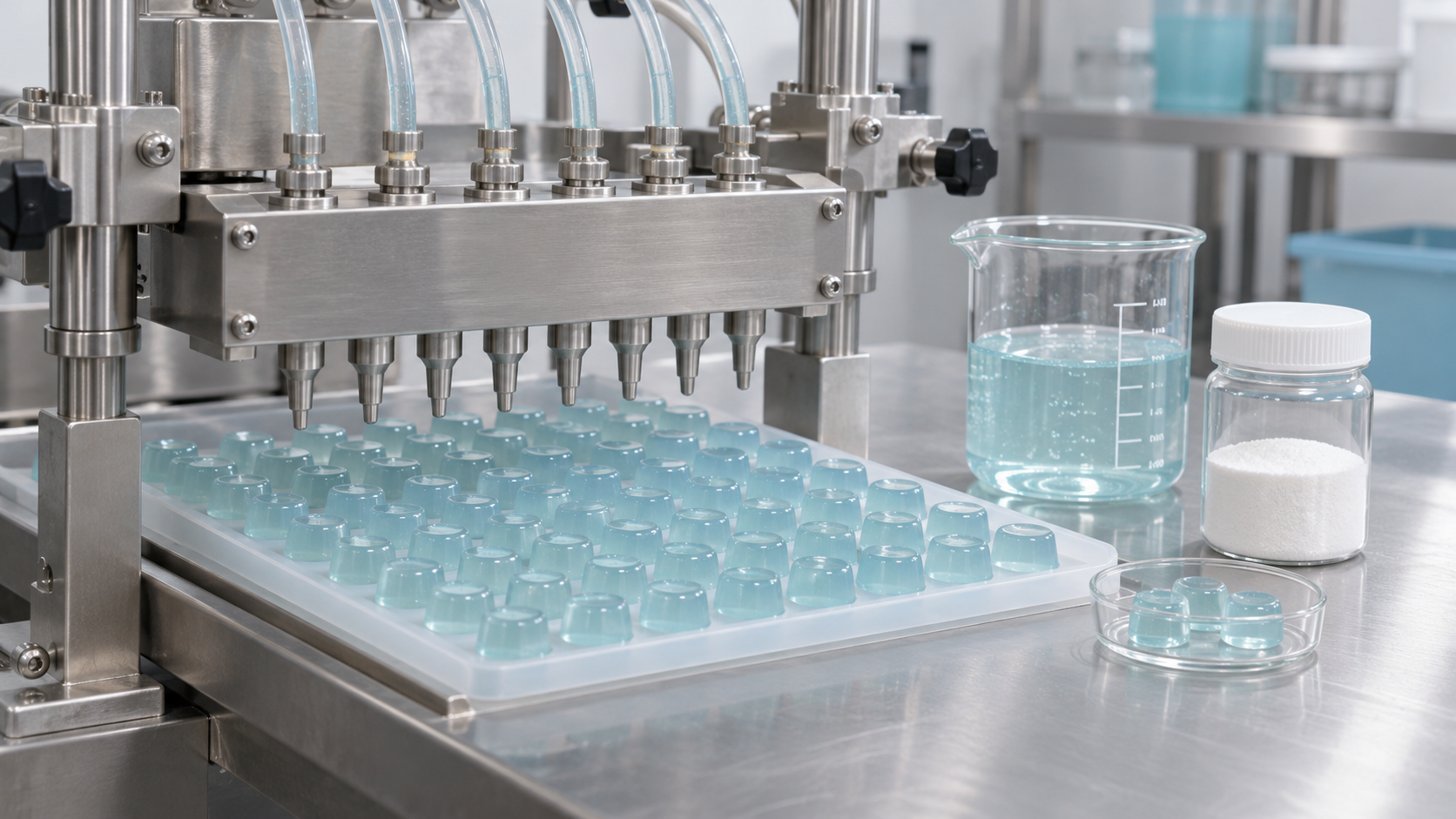
4 Make Sure the Laboratory Method Works for Gummies
A method suitable for pure creatine powder may not automatically recover creatine accurately from a gummy. Gelatin, pectin, sugars, polyols, acids, flavours and colours can affect sample preparation or analytical recovery. The laboratory should therefore evaluate suitable extraction, specificity, recovery, precision and matrix interference.
If the analytical result differs from the theoretical input, SRS can work with the customer, OEM and laboratory to compare:
- the calculation basis;
- raw-material batch result;
- sample identity and sampling location;
- production records;
- extraction procedure;
- reporting units;
- repeat or confirmation-testing plan.
The objective is not to continue testing until the batch passes. It is to determine whether the discrepancy comes from the material, production process, sampling, method or stability.
5 Use Stability Testing to Improve the Formula
Creatine can convert to creatinine in aqueous environments. Temperature, pH and water activity influence the rate, but results from buffered solutions cannot predict a finished gummy directly.
The stability programme should monitor justified attributes such as:
- creatine assay
- creatinine
- moisture/water activity
- pH levels
- gummy weight
- texture/sticking
- microbiology
- packaging
- sensory changes
Accelerated studies can reveal weaknesses and compare trial formulations, but they do not automatically establish the final shelf life. Real-time testing under intended commercial conditions remains important.

6 Packaging and Artwork Complete the Control System
The commercial package influences moisture exposure, temperature history and repeated consumer opening. Bottle or pouch selection, closure, induction seal, desiccant compatibility and transport conditions should be included in the development assessment.
The artwork must also match the tested product:
- creatine quantity per declared serving;
- number of gummies per serving;
- ingredient naming and calculation basis;
- responsible manufacturer or distributor;
- permitted claims;
- market-specific directions and warnings.
ANVISA confirmed in September 2026 that applicable Brazilian supplement requirements include stability studies and other technical evidence needed to support product quality and safety. Requirements still need to be reviewed separately for every destination market.
Develop Your Creatine Gummy With SRS
A creatine gummy project should begin with a defined dose, a suitable raw-material grade and a testing plan—not with a shelf-life claim. SRS Nutrition Express works with brands, formulators, OEM manufacturers and laboratories to connect these stages.
Share your target dose, gummy weight, and destination market. SRS can recommend a suitable starting grade and documentation package.
ℹ Evidence Boundaries
- The ANVISA action involved specified products and lots, not every creatine gummy.
- The public notice did not establish the root cause of the failed content results.
- Model-solution stability data cannot predict every gummy formulation.
- A passing release result does not prove compliance throughout shelf life.
- SRS raw-material documents do not replace finished-product validation.
- Final formulation, method approval and lot disposition remain the responsible manufacturer’s decisions.
Recommended Reading
References
- Uzzan M, Nechrebeki J, Zhou P, Labuza TP. Effect of water activity and temperature on the stability of creatine during storage. Drug Development and Industrial Pharmacy. 2009;35(8):1003–1008.
- Agência Nacional de Vigilância Sanitária. Anvisa proíbe suplemento irregular e suspende lotes de creatina. June 25, 2026.
- Agência Nacional de Vigilância Sanitária. Anvisa alerta e orienta sobre o prazo de adequação às regras de regularização de alimentos. September 1, 2026.
- Kreider RB, Kalman DS, Antonio J, et al. Common questions and misconceptions about creatine supplementation. Journal of the International Society of Sports Nutrition. 2021;18:13.
Post time: Nov-04-2026


