

At SupplySide Global 2026, creatine appeared in gummies, soft chews, crunchy chews, beverages, release-cap systems and more refined powder formats. Yet behind many of these new concepts, the principal ingredient remained familiar: creatine monohydrate.
SupplySide Supplement Journal’s November 11 report observed that although branded creatine products were becoming increasingly visible, most were still based on creatine monohydrate. The innovation was happening around the ingredient—in delivery format, physical characteristics, convenience, packaging and consumer positioning. [1]
That creates an important opportunity for supplement brands.
You may not need to introduce another form of creatine to launch something new. The better question could be:
How can an established ingredient be developed into a product that fits your market more precisely?
One Ingredient Can Become Many Different Products
Creatine monohydrate is no longer limited to a large sports-nutrition tub.
Depending on the intended customer, serving occasion and sales channel, it can become:
- • a conventional powder in a jar or pouch
- • a finer powder for a smoother preparation experience
- • a portable single-serving stick pack
- • a capsule or tablet product
- • a flavoured or multi-ingredient powder
- • a creatine gummy or chewable product
- • a private-label product with customised packaging and artwork
These products may use the same established form of creatine, but they do not create the same consumer experience.
A gym-focused powder, a women’s wellness stick pack and a convenient chewable product can occupy very different positions in the market. Their development requirements will also differ.
Choose the Creatine Grade Around the Format
The grade should follow the finished-product brief—not the other way around.
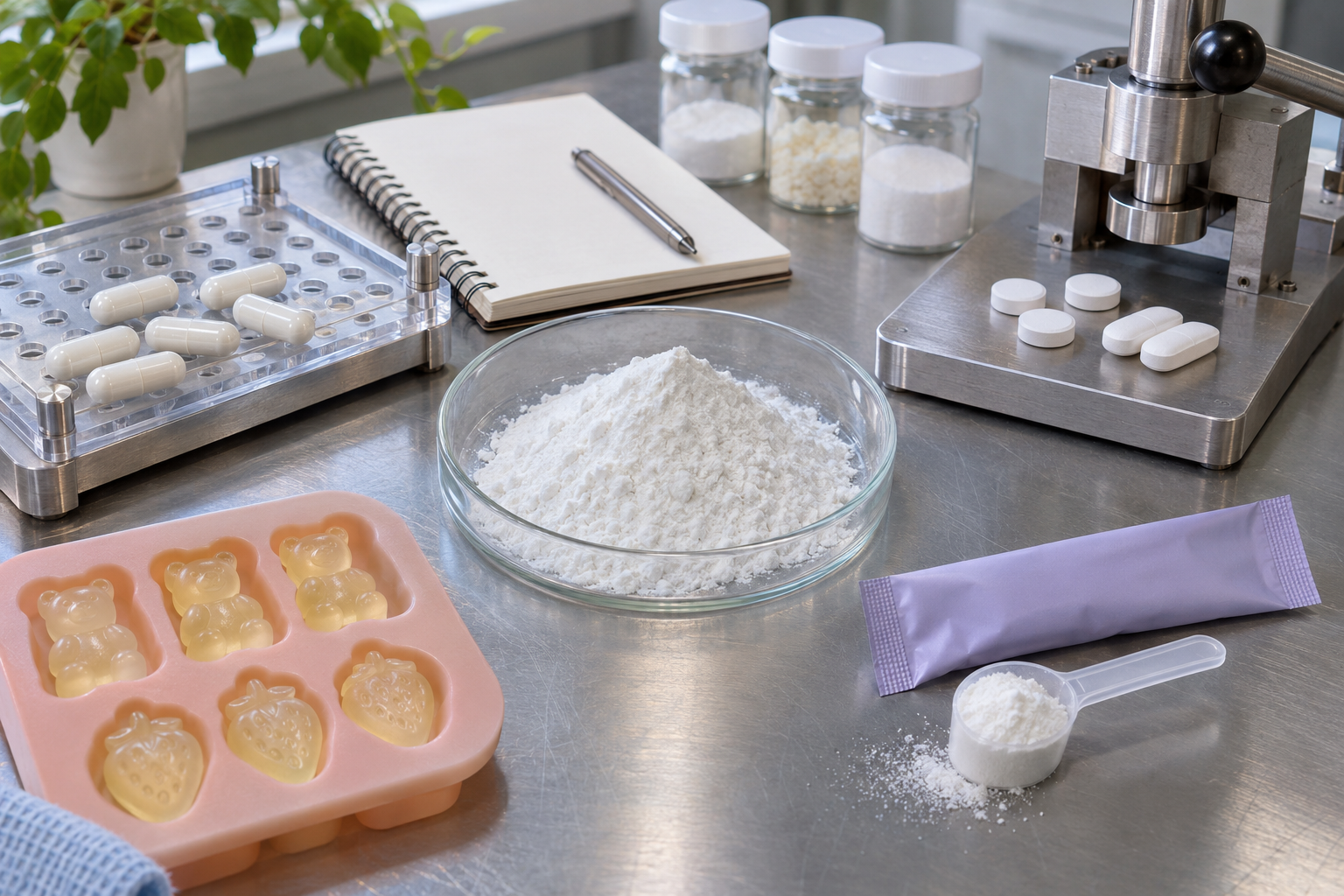
For a powder product, the brand may prioritise mouthfeel, appearance, dispersion or package fill. Capsule projects must consider shell size, target fill weight and the number of capsules required per serving. Tablet development introduces questions about flow, compression and tablet size.
Gummies and chews require an entirely different development path because a gram-level creatine serving must be balanced with the weight, texture, flavour and number of units per serving.
SRS Nutrition Express can discuss different creatine grades based on the intended application and arrange representative material for formulation and production trials.
Custom Density Can Help the Product Fit the Package
Two creatine powders with the same net weight may occupy different volumes.
For example: 500 g of powder at a loose bulk density of 500 g/L theoretically occupies approximately 1.0 L. At 400 g/L, the same weight occupies approximately 1.25 L before allowing for headspace and subsequent settling.
This difference may determine whether an existing jar can support a new creatine SKU.
Density also matters when a brand wants to:
- ✔ retain an existing container across several product lines;
- ✔ reduce excessive visible headspace;
- ✔ accommodate a scoop;
- ✔ improve capsule or tablet development;
- ✔ plan filling-line trials;
- ✔ compare standard and finer creatine grades.
Share the proposed container capacity, target net weight and serving format with SRS. We can discuss an appropriate density direction and supply a grade for physical filling trials.
Actual packaging approval should still be based on the commercial formulation, filling equipment and transport conditions.
Packaging Is Part of the Product Experience
Packaging should reflect how and where the customer will use the product.
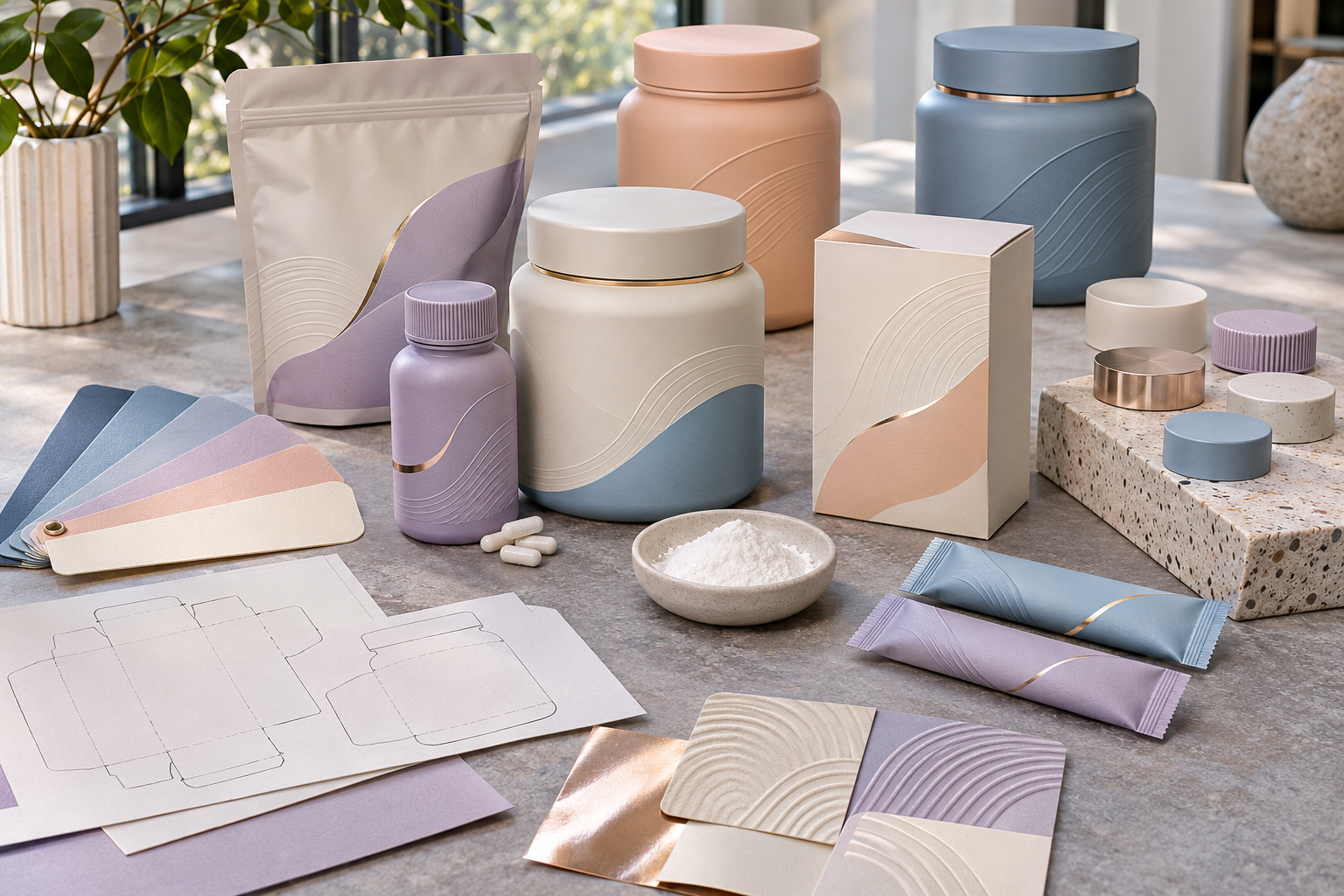
A traditional sports-nutrition product may suit a large tub and scoop. A premium or lifestyle-oriented product might use a compact jar, pouch or individual stick packs. Capsules and tablets require suitable bottles and count configurations, while gummies introduce their own moisture, sealing and unit-count considerations.
SRS can work with an existing packaging range or help develop a new packaging brief around:
The objective is not simply to place creatine into a container. It is to develop a product in which the ingredient grade, dosage form and packaging work together.
Build a Creatine Product Under Your Own Brand
A private-label creatine product should not feel like a generic powder with a different logo.
Brands can differentiate through the intended audience, serving format, visual identity, flavour direction, pack size and everyday use experience—without suggesting that the underlying creatine is physiologically “stronger” than conventional creatine monohydrate.
SRS can support product development from the initial concept through to a workable commercial brief, including:
- creatine monohydrate grade selection;
- particle-size and density discussions;
- powder, capsule, tablet and gummy options;
- representative samples;
- specifications and lot COAs;
- packaging selection;
- label and artwork coordination;
- private-label production planning.
Bring Us the Product You Want to Create
Start with the market opportunity rather than a catalogue grade. Tell us:
- who the product is for;
- whether you want powder, capsules, tablets or gummies;
- the target creatine amount per serving;
- the preferred pack size;
- whether you already have a container;
- the destination market;
- the expected order quantity.
SRS Nutrition Express can then help translate that concept into a creatine grade to test, a dosage format to evaluate and a packaging brief your development team can use.
The market may still be built around creatine monohydrate—but the finished products do not all have to look, feel or function the same way.
Evidence Boundaries
- Different particle sizes and densities do not make creatine monohydrate inherently more effective.
- Packaging volume calculations are preliminary and must be confirmed through physical filling trials.
- Capsules, tablets, gummies and beverages require application-specific development and finished-product testing.
- Product claims, labels and formulations must meet the requirements of the destination market.
- Available customisation options depend on dosage format, order volume and technical feasibility.
Recommended Reading
References
- Collias N. Creatine in 2026: 9 Big Takeaways From SupplySide Global. SupplySide Supplement Journal. November 11, 2026.
Post time: Nov-11-2026


