

Electrolytes used to arrive with a fairly obvious context: a long run, a hot training session or a bottle passed along the sideline.
Now they appear in office drawers, travel bags and morning routines.
PepsiCo reported in November 2026 that hydration powders were expanding across a wider range of daily occasions. Its product strategy now separates different hydration needs instead of presenting one formula as appropriate for every situation.[1]
1 “Everyday Hydration” Is Not a Mineral Specification
The phrase sounds clear on the front of a pack, but it does not tell the formulator how much sodium, potassium or magnesium the product should provide.
A person walking to work in mild weather does not face the same fluid and electrolyte losses as someone cycling for several hours in the heat.
ACSM notes that most people exercising for less than approximately 60–90 minutes under normal conditions are unlikely to become meaningfully depleted of electrolytes. Needs become more relevant during prolonged exercise, heavy sweating, heat exposure or other demanding conditions.[2]
This does not mean an everyday electrolyte product has no place. It means that “daily wellness” and “endurance hydration” should not automatically share the same dose, serving instructions or marketing language.
The intended occasion needs to be defined before the mineral blend.

2 Start With Sodium—but Do Not Stop There
Sodium is usually the central electrolyte in products designed to replace sweat losses. However, an effective sports formula cannot be created by copying one sodium number from a competitor.
Relevant questions include:
- How long and intensely will the consumer exercise?
- Will the product be used in heat?
- How much water accompanies each serving?
- Is it intended before, during or after activity?
- Will the consumer take more than one serving?
- Does the formula contain carbohydrate?
- How salty can the finished drink taste?
ACSM’s consumer guidance notes that sweat losses vary widely and that heavy sweaters may lose approximately 500–700 mg of sodium during an hour of vigorous exercise. That figure is an illustration, not a universal formulation target.[2]
An everyday hydration product may use a lighter mineral and flavour profile. A product intended for prolonged exercise may require a different concentration and clearer use instructions.
3 The Salt Weight Is Not the Elemental Amount
Electrolyte formulations become confusing when the mineral compound and the declared mineral are treated as the same number.
Potassium citrate, for example, is not 100% potassium. Magnesium citrate is not 100% magnesium. The amount weighed into the blend is therefore higher than the amount of elemental mineral declared on the label.
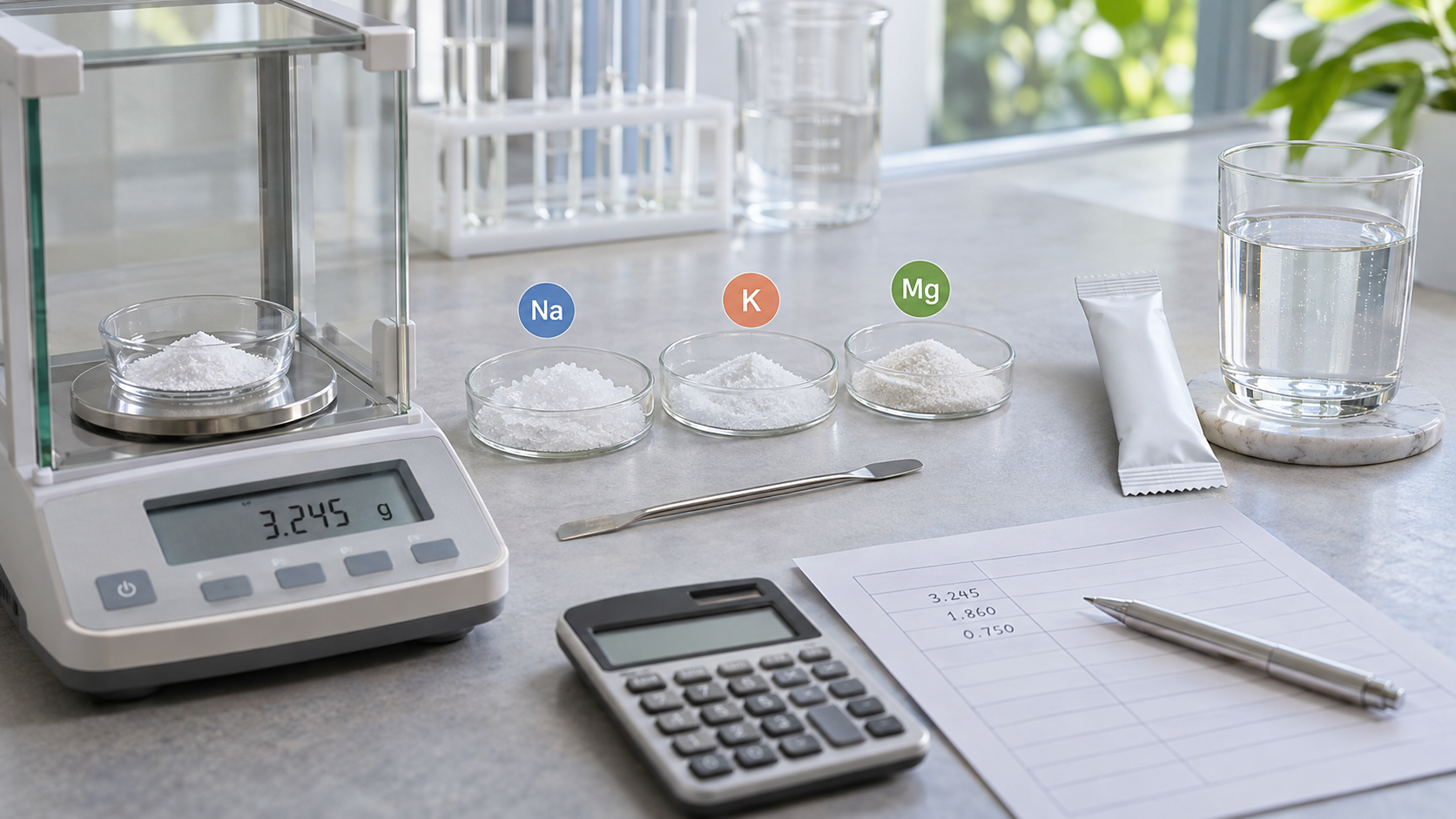
NIH explains that dietary-supplement labels declare the amount of elemental potassium rather than the total weight of the potassium-containing compound. Potassium may be supplied through chloride, citrate, phosphate, bicarbonate, gluconate and other forms.[3]
The same principle applies when calculating other minerals. Before comparing quotations or specifications, buyers should confirm:
- Exact chemical form
- Hydration state where relevant
- Assay basis
- Elemental-mineral percentage
- Required quantity per serving
- Label target conversion calculation
4 The Formula Still Has to Taste Drinkable
A technically impressive electrolyte panel can produce a drink that consumers do not want to finish. Sodium and potassium salts may contribute salty, bitter or metallic notes. Magnesium salts can introduce additional bitterness or affect clarity.
Brands should test the proposed mineral blend at the actual serving concentration—not only taste each ingredient separately. The trial should control:
- Powder quantity
- Water volume & temperature
- Mixing method
- Flavour system
- Sweetness and acidity
- Mineral aftertaste
- Sediment after standing
- Servings per day
5 Stick-Pack Convenience Creates Physical Limits
Increasing the electrolyte content increases the amount of mineral salt required. Flavours, acids, sweeteners and functional ingredients need space as well. The result can be a sachet that is larger than expected or a powder that flows poorly.
Pilot production should confirm achievable fill weight, seal quality, powder dust, dose variation and behaviour during storage.
6 One Electrolyte Product Should Not Promise Every Occasion
A clearer approach is to define one primary use occasion and build the dose, flavour, package and instructions around it.
Developing an Electrolyte Powder or Stick Pack?
SRS Nutrition Express can help translate the intended hydration occasion into a raw-material and sample brief. We review mineral forms, elemental-content calculations, and provide samples for formulation trials.
Evidence Boundaries
- Electrolyte requirements vary with diet, health status, activity, climate and individual sweat losses.
- A value reported for athletes or heavy sweaters is not a universal daily dosage recommendation.
- “Everyday hydration” is a positioning concept, not a standardised mineral specification.
- Elemental-mineral content cannot be inferred from total compound weight without the correct conversion.
- Raw-material specifications do not replace finished-product sensory, fill, stability and compliance testing.
- People with medical conditions or using relevant medications may require individual professional guidance.
Recommended Reading
- Sports Nutrition Is Leaving the Gym. Are Ingredient Specifications Keeping Up?
- When Evidence-Based Doses Do Not Fit the Product Format
- Can One Raw-Material Specification Work for Every Finished Product?
- COA vs Ingredient Qualification: Why One Document Is Not Enough
References
- PepsiCo. Hydration Powders: PepsiCo Expands Personalized Hydration Throughout the Day. November 3, 2026.
- American College of Sports Medicine. 9 Facts About Hydration & Electrolytes. July 29, 2025.
- National Institutes of Health, Office of Dietary Supplements. Potassium: Fact Sheet for Health Professionals.
- U.S. Food and Drug Administration. Dietary Supplement Labeling Guide: Chapter IV—Nutrition Labeling.
Post time: Nov-17-2026


