

Sports nutrition used to have a fairly predictable setting: a large tub, a shaker bottle and someone preparing a drink before or after training.
That setting is changing.
Creatine is appearing in sachets, capsules, gummies and chews. Electrolytes are being carried to offices, flights and outdoor events. Protein has moved into snacks, coffee-style drinks and everyday nutrition products.
Recent industry reporting reflects this shift. SupplySide Global 2026 featured creatine across beverages, gummies and chewable formats, while PepsiCo described hydration powders as part of consumers’ broader daily wellness routines—not only exercise recovery.[1][2]
The ingredient may be familiar. The conditions under which it must perform are not.
The Same Ingredient Can Face a Very Different Job
A creatine monohydrate specification may confirm identity, assay, moisture and relevant impurities. Those requirements remain important whether the ingredient enters a tub, stick pack or capsule.
However, they do not answer every product-development question.
A powder sold in a large tub can be scooped and shaken vigorously. A stick pack may be poured into a narrow-neck bottle and mixed with a few movements. A capsule must fit a defined shell volume. A gummy introduces water, acidity and heat.
The chemical identity has not changed, but the ingredient’s technical job has.

That is why a specification designed only to release the raw material may be insufficient for selecting the best grade for a particular finished product.
Assay Is the Starting Point, Not the Whole Specification
A high assay establishes how much of the intended ingredient is present under the stated method and reporting basis. It does not automatically establish:
- [•] how much volume the powder occupies;
- [•] whether it flows consistently through filling equipment;
- [•] how quickly it wets or disperses;
- [•] whether it settles in a beverage;
- [•] whether it creates grittiness;
- [•] whether it remains stable after processing;
- [•] whether the finished serving delivers the intended amount.
Physical properties can become commercially important even when two grades meet the same chemical limits.
USP defines bulk density as the relationship between powder mass and bulk volume, including the spaces between particles. This means two compliant raw materials with the same net weight can require different container volumes or produce different capsule-fill results.[3]
Particle-size information also needs context. A mesh designation alone cannot fully describe a distribution of particles or predict performance in every formula.
Different Formats Need Different Technical Questions
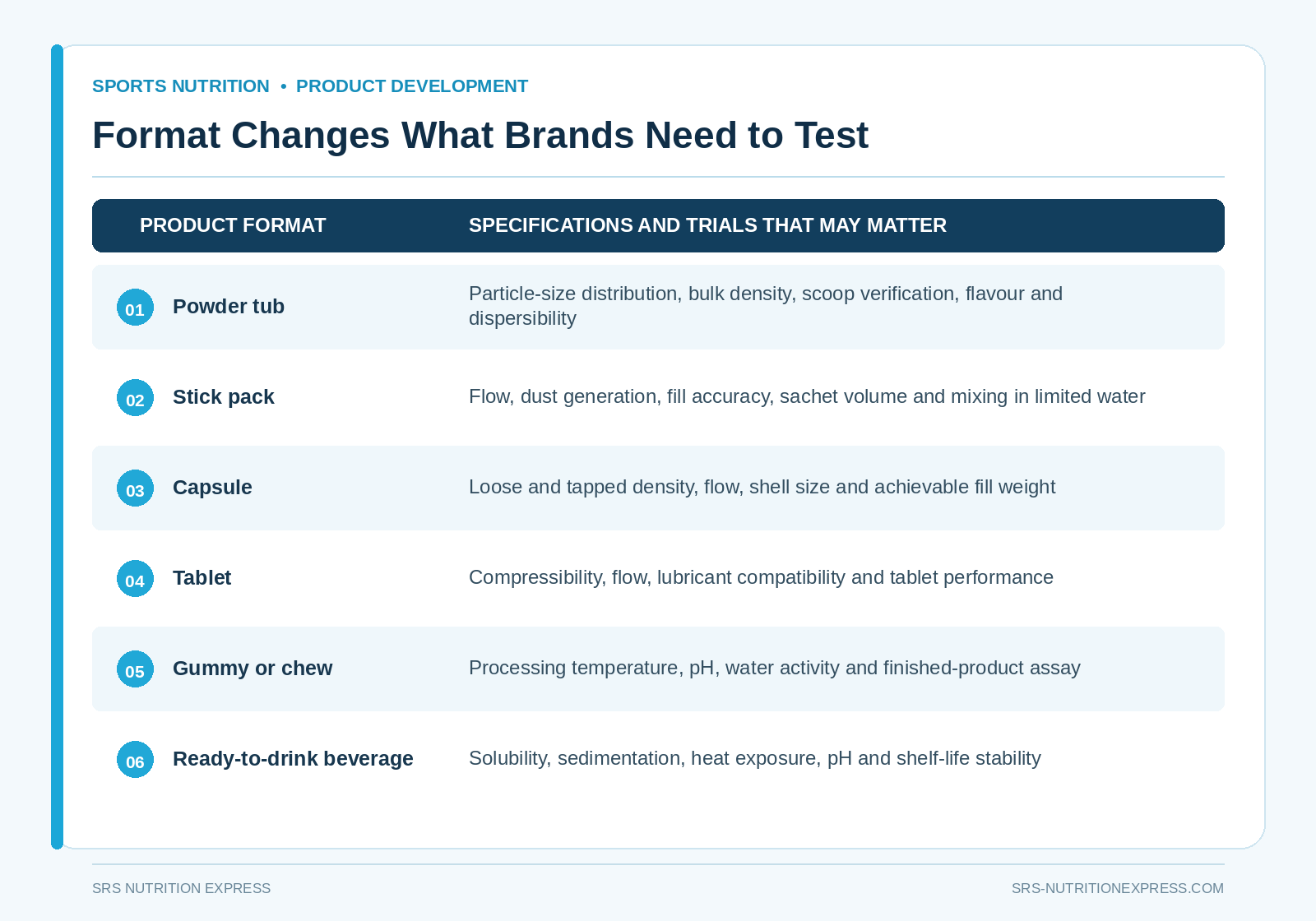
These are not universal specifications for every product. They are questions that help determine what should be tested.
A raw-material result should not be used to claim that a finished beverage, gummy or chew will remain compliant throughout shelf life. The actual formula and process must be evaluated.
Everyday Use Changes the Test Conditions
When sports nutrition leaves the gym, convenience becomes part of performance.
A consumer may prepare a product in cold water at a desk, pour it into a bottle during travel or take it without a shaker. A formulation that works under intensive laboratory mixing may perform differently under these conditions.
Product-development trials should therefore reflect the intended use occasion:
- the proposed powder dose;
- actual water volume and temperature;
- the intended bottle, cup or shaker;
- realistic mixing time;
- standing time before consumption;
- flavour and mouthfeel;
- sediment remaining after drinking.
The specification and the consumer-use test answer different questions. Both may be necessary.
A Wider Audience Does Not Make Every Sports Dose Appropriate
Moving sports nutrition into everyday wellness also changes the consumer and the message.
An electrolyte product intended for prolonged exercise in hot conditions may not need the same mineral profile as a lightly flavoured daily hydration product. A performance formula developed for trained athletes should not automatically be repositioned for every consumer without reviewing its dose, instructions and evidence.
FDA requires US dietary-supplement labels to state serving size and the amount of each declared dietary ingredient, except where proprietary-blend provisions apply. Manufacturers are also responsible for establishing specifications for identity, purity, strength, composition and contaminant limits.[4][5]
Market positioning may become broader, but formulation and quality responsibilities do not become lighter.
What Should Brands Add to an Ingredient Brief?
Before requesting samples or quotations, brands should define more than the ingredient name and assay.
- finished-product format
- target amount per serving
- serving size and number of units
- container, capsule or sachet dimensions
- intended water volume and mixing conditions
- target market and applicable specification
- processing temperature and pH where relevant
- sensory expectations
- shelf-life target
- required testing and documentation
The supplier can then recommend a grade for evaluation instead of assuming that one standard material will fit every application.
Developing Sports Nutrition Beyond the Traditional Tub?
SRS Nutrition Express can help compare ingredient grades against the intended product format—not only against a generic raw-material specification.
Share the ingredient, target dose, dosage form, package dimensions, processing conditions and destination market. Depending on the project, SRS can provide available specifications, representative COAs, samples and relevant particle-size, density or technical information for formulation and filling trials.
For creatine, protein, amino-acid and mineral projects, the objective is not to declare one grade universally superior. It is to identify a material that your quality team can approve and your finished product can use successfully.
Evidence Boundaries
- Market reporting indicates category direction but does not predict the success of an individual product.
- A compliant raw-material assay does not establish finished-product stability or dose uniformity.
- Particle size, mesh and bulk density describe different material properties.
- Laboratory dispersion does not guarantee the same performance under consumer-use conditions.
- Final specifications must reflect the formula, process, package, destination market and approved quality procedures.
Recommended Reading
References
- SupplySide Supplement Journal. Creatine in 2026: 9 Big Takeaways From SupplySide Global. November 2026.
- PepsiCo. Hydration Powders: PepsiCo Expands Personalized Hydration Throughout the Day. November 2026.
- United States Pharmacopeia. General Chapter <616>: Bulk Density and Tapped Density of Powders.
- U.S. Food and Drug Administration. Dietary Supplement Labeling Guide: Chapter IV—Nutrition Labeling.
- U.S. Food and Drug Administration. Current Good Manufacturing Practice in Manufacturing, Packaging, Labeling, or Holding Operations for Dietary Supplements: Small Entity Compliance Guide.
Post time: Nov-17-2026


