

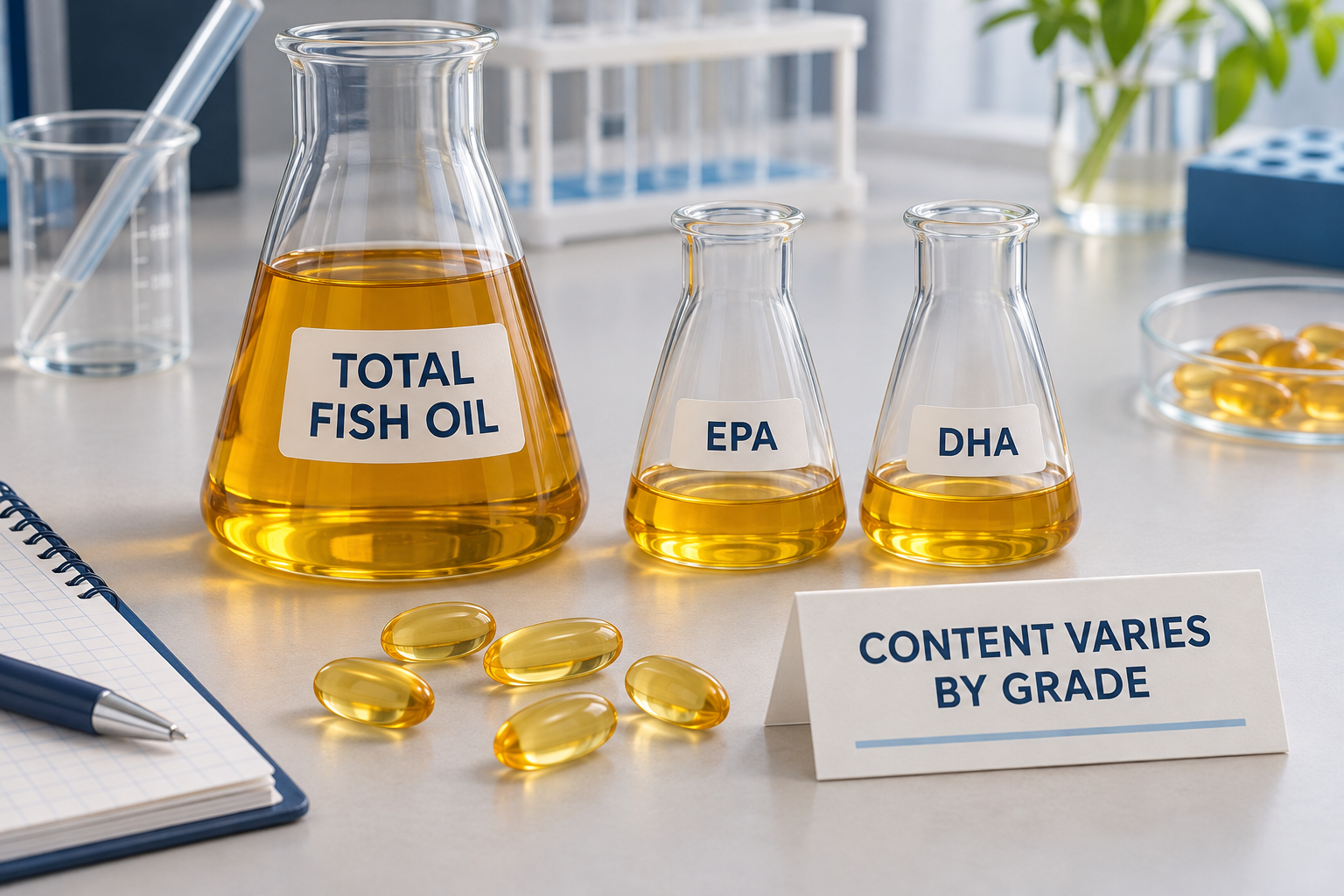
A fish oil bottle may show “1,000 mg” prominently on the front. Turn it around, and the Supplement Facts panel may list 180 mg EPA and 120 mg DHA.
The numbers are not necessarily contradictory. They answer different questions.
The 1,000 mg usually describes the total oil in the serving. The EPA and DHA values describe specific fatty acids contained within that oil. For consumers, this affects how products are compared. For brands and formulators, it affects oil input, softgel size, capsule count, manufacturing cost and label verification.
Three Numbers Can Describe the Same Serving
A conventional 1,000 mg fish oil serving might provide:
- • 180 mg EPA;
- • 120 mg DHA;
- • 300 mg combined EPA and DHA.
The remaining weight may include other fatty acids and oil components. It should not automatically be described as missing material or filler.
NIH notes that a typical fish oil supplement may provide approximately 300 mg of combined EPA and DHA, although commercial products vary widely.[1]
The label should therefore distinguish clearly between:
- total fish oil per serving;
- EPA per serving;
- DHA per serving;
- combined EPA and DHA, where declared.
Under US dietary-supplement labelling rules, the Supplement Facts panel generally declares the quantitative amount of each listed dietary ingredient per serving. Serving size and directions also need to be aligned.[2]
Convert the Label Claim Before Requesting a Price
Suppose a brand wants to deliver 600 mg of combined EPA and DHA per daily serving.
This simplified calculation shows why quotations based only on price per kilogram can be misleading. The more concentrated oil may cost more per kilogram but require less oil, fewer or smaller capsules and less packaging per effective serving.
Actual formulation calculations must use the approved specification and assay basis. The buyer should confirm whether the percentage refers to EPA+DHA, total omega-3, fatty-acid methyl esters or another reporting basis.
Does TG or EE Tell You Which Oil Is Better?
A softgel must hold the required oil volume while remaining practical to manufacture, package and swallow.
When the selected oil has a lower concentration, the brand may need to:
- increase the number of softgels per serving;
- use larger softgels;
- reduce the intended EPA+DHA claim;
- accept a larger bottle and higher freight volume.
The calculation should use the oil’s measured density and the proposed capsule’s validated fill capacity. Capsule size names alone are not sufficient because shell geometry, fill formulation and equipment settings can differ. The formulation brief should state both the desired EPA+DHA dose and the maximum acceptable daily capsule count before a supplier recommends a grade.
A Raw-Material COA Cannot Verify the Finished Serving
A supplier COA can confirm that the tested oil lot met its approved EPA and DHA specifications. It cannot prove that every finished softgel contains the intended amount. Finished-product delivery also depends on:
- actual oil assay;
- weighing accuracy;
- fill-weight control;
- blend uniformity;
- processing losses;
- shelf life stability.
For US dietary supplements, manufacturers must establish specifications for finished batches and verify that applicable specifications are met.[3] Supplier documentation supports this process but does not replace finished-product controls.
A brand should connect three records:
- the commercial-lot fish oil COA;
- the manufacturing batch record and fill-weight data;
- the finished-product EPA and DHA results.
Overages Should Have a Technical Reason
Adding extra oil “to be safe” is not a complete control strategy. Any overage should be justified using assay variability, manufacturing capability, analytical variability and stability data.
The appropriate level is product-specific. It cannot be copied automatically from another oil, softgel format or packaging system.
What Should Buyers Include in the RFQ?
Before requesting a fish oil quotation, provide:
This allows suppliers to compare grades by the cost and feasibility of the finished serving—not only by the price of one kilogram of oil.

Planning a Fish Oil Softgel?
SRS Nutrition Express can help compare available fish oil grades by EPA and DHA concentration, proposed oil input, capsule format and documentation requirements.
Share your target EPA and DHA per serving, preferred capsule count, destination market and estimated annual volume. SRS can provide available specifications, representative COAs and samples for technical and commercial evaluation.
Evidence Boundaries
- [!] Total fish oil weight does not establish EPA and DHA content.
- [!] A theoretical concentration calculation does not replace a commercial-lot assay.
- [!] Raw-material compliance does not independently prove finished-softgel content.
- [!] Capsule capacity must be confirmed with the selected oil, shell and filling equipment.
- [!] Overages require product-specific manufacturing and stability justification.
Recommended Reading
References
- National Institutes of Health, Office of Dietary Supplements. Omega-3 Fatty Acids: Fact Sheet for Health Professionals.
https://ods.od.nih.gov/factsheets/Omega3FattyAcids-HealthProfessional/ - U.S. Food and Drug Administration. Dietary Supplement Labeling Guide: Chapter IV—Nutrition Labeling.
https://www.fda.gov/food/dietary-supplements-guidance-documents-regulatory-information/dietary-supplement-labeling-guide-chapter-iv-nutrition-labeling - Electronic Code of Federal Regulations. 21 CFR Part 111—Current Good Manufacturing Practice for Dietary Supplements.
https://www.ecfr.gov/current/title-21/chapter-I/subchapter-B/part-111 - Codex Alimentarius Commission. Standard for Fish Oils, CXS 329-2017.
https://www.fao.org/fao-who-codexalimentarius/
Post time: Nov-10-2026


