

Five-hundred-mesh creatine is often positioned as a premium grade. The powder looks finer, and under suitable preparation conditions it may create a smoother consumer experience. But does that justify paying more?
The answer depends less on the price per kilogram than on what the finer grade changes in the finished product. A small raw-material premium may add little to each serving, but upgrading has limited value if consumers cannot perceive the difference or the powder creates new packaging and production costs.
Start With the Cost Per Finished Product
Comparing supplier quotations by price per kilogram is only the first step. The incremental ingredient cost can be calculated as:
If 500-mesh creatine costs $1.00/kg more than the alternative grade:
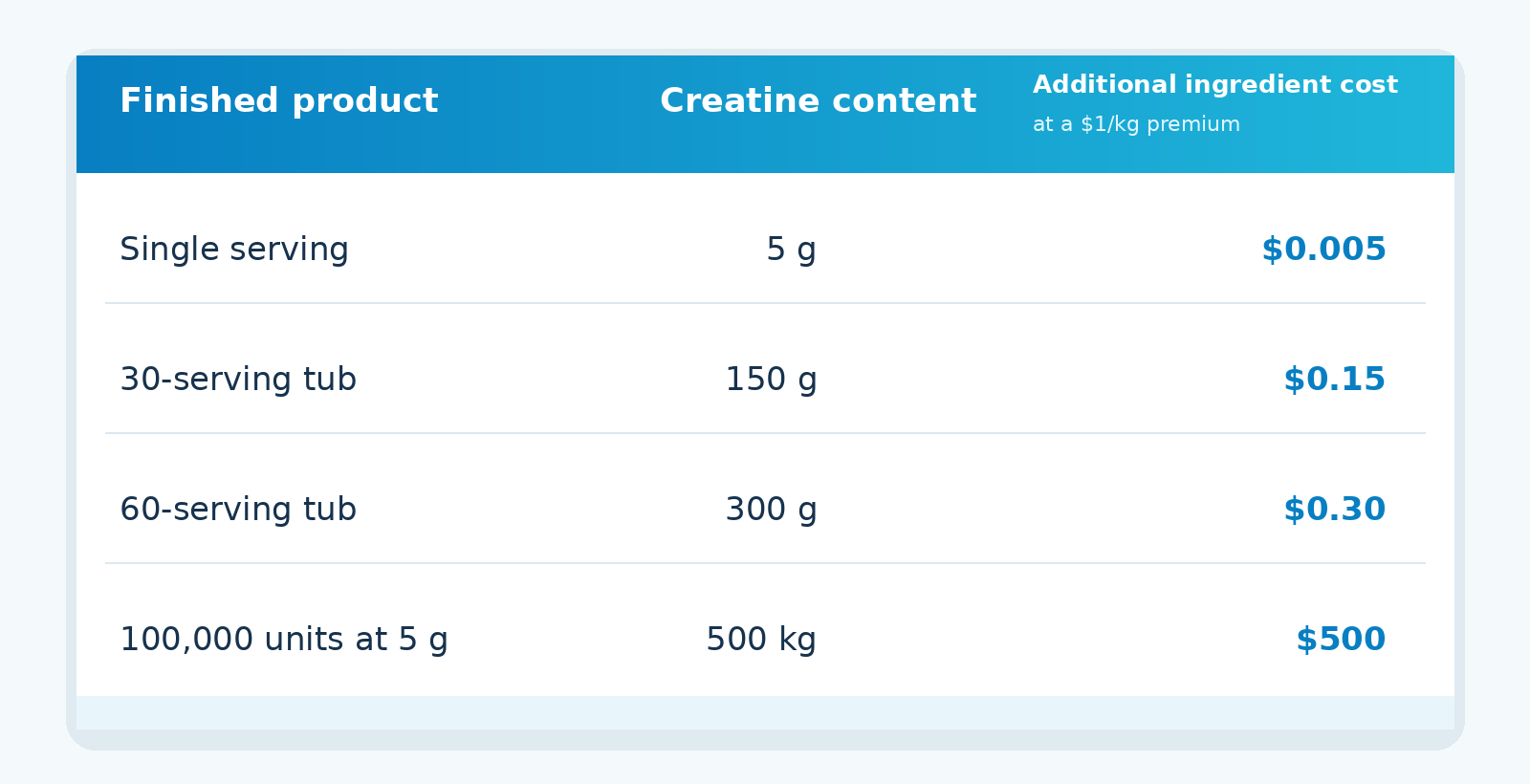
These figures are illustrative, not current SRS quotations. Actual pricing depends on quantity, packaging, destination, delivery terms and market conditions.
A relatively small per-unit difference may be acceptable for a premium product. The decision becomes less attractive if the finer grade also requires a larger container, slower filling or additional processing aids.
What Is the Brand Actually Paying For?
Brands should not pay more because “500 mesh” sounds technically advanced. The commercial value should come from a product attribute that matters to the target customer. Possible advantages to evaluate include:
- ✔ finer visual appearance;
- ✔ reduced perception of coarse particles;
- ✔ smoother mouthfeel in the intended preparation;
- ✔ less visible residue under specified mixing conditions;
- ✔ stronger premium positioning;
- ✔ clearer differentiation from standard creatine products.
Particle size can influence perceived grittiness, but sensory response also depends on particle concentration and the surrounding medium.[1] A favourable result in plain water may therefore change after sweeteners, acids, flavours or other active ingredients are introduced.
The relevant question is not whether the raw powder feels finer between two fingers. It is whether the finished product delivers a meaningful and repeatable difference.
When Is 500 Mesh More Likely to Add Value?
Premium Single-Ingredient Powders
Consumers interact directly with the powder, water dispersion and residue. A noticeable sensory improvement may support a higher-end position.
Lifestyle-Oriented Creatine Products
Products designed for women, healthy-aging consumers or people outside traditional bodybuilding may benefit from a more refined experience and less industrial-looking powder.
Single-Serving Stick Packs
A convenient format and fine powder can support premium positioning. However, the grade must still feed and fill consistently in the intended equipment.
Products With Simple Formulas
When creatine is the dominant ingredient, differences between grades may be easier to notice than in a complex blend.
These are development hypotheses, not guarantees. Comparative samples should be tested in the intended formula.
When Might 200 Mesh Already Be Enough?
Five-hundred mesh is not automatically the best commercial choice. A 200-mesh grade may already meet the brief when:
- the product is consumed in a large volume of liquid;
- strong flavours or other powders dominate the sensory experience;
- the finished format is a capsule or tablet;
- the brand competes primarily on price;
- existing customers report no meaningful texture problem;
- the current material runs reliably in production.
Upgrading an ingredient without improving a consumer-relevant attribute adds cost but not necessarily value.
For capsules, density and achievable fill weight may matter more than extremely fine particle size. For tablets, compression performance must be evaluated. In multi-ingredient powders, another component may remain the main source of grittiness.
Include Packaging and Production in the Calculation
Fine powders can differ in loose density, tapped density, cohesion and flow. These differences may affect:
Recent research shows that powder-flow behaviour reflects interacting properties such as particle-size distribution, density, morphology and surface characteristics; it cannot be predicted reliably from a mesh label alone.[2]
A meaningful cost comparison should therefore include the finished-product trial, not only the raw-material quotation.
Use a Simple Upgrade Decision
1. Can the target consumer perceive a worthwhile difference?
2. Does the proposed grade run reliably in the intended process?
3. What is the total additional cost per finished unit?
4. Can the brand explain the upgrade accurately without implying superior efficacy?
Compare the Two Grades Before Deciding
SRS Nutrition Express supplies 200-mesh and 500-mesh creatine monohydrate for comparative product-development trials. Share your product format, creatine dose, annual volume, packaging, destination and filling method. SRS can provide representative samples, applicable specifications, lot COAs, available particle-size or density information and separate commercial quotations for review.
Evidence Boundaries
- A higher mesh number does not prove better efficacy or bioavailability.
- Mesh designation does not describe the complete particle-size distribution.
- Sensory differences depend on dose, liquid, formula and preparation conditions.
- The lowest raw-material price does not always produce the lowest finished-product cost.
- Commercial suitability requires testing with the proposed grade and equipment.
Recommended Reading
- Requesting a 500-Mesh Creatine Sample? Test These Four Things Before You Approve It
- Can a Finer Creatine Powder Make a Premium Product Look Less Premium?
- Creatine Mesh Size vs Particle Size Distribution: Why Dv(10), Dv(50) and Dv(90) Matter
References
- Imai E, Hatae K, Shimada A. Oral perception of grittiness: effect of particle size and concentration of the dispersed particles and the dispersion medium. Journal of Texture Studies. 1995;26(5):561–576.
- Owasit A, et al. Predicting powder blend flowability from individual component properties. Pharmaceutical Research. 2025;42:665–683.
- United States Pharmacopeia. General Chapter <616>: Bulk Density and Tapped Density of Powders.
Post time: Oct-15-2026


