

MINERAL INGREDIENTS · STICK PACK DEVELOPMENT
Who Said Mineral Stick Packs Belong in the Gym?
Sports nutrition made the stick pack familiar. It does not own the format.
Put a mineral powder into a slim sachet and the packaging brief often writes itself: athlete, water bottle, beads of sweat. Sports nutrition made the stick pack familiar, but it does not own the format. The same tear-pour-drink ritual can work at a desk, on a flight, during hot weather or as part of an evening routine.
Moving beyond the gym, however, takes more than replacing the athlete on the artwork. The product still has to carry a meaningful dose, taste acceptable, flow through a filling line and meet the rules of its destination market. A fresh use occasion can open the door; only a workable formula keeps it open.
USE OCCASION
The Gym Was a Launchpad, Not a Boundary
Electrolytes gave stick packs a clear job after exercise, and that clarity helped the format grow. But portability is useful in many routines. Magnesium can sit in an evening product; a mineral blend can be designed for travel; a hot-weather sachet can serve consumers who would never describe themselves as athletes.
The use occasion must shape more than the campaign. Someone mixing a product before bed may want a different flavour, water volume and serving size from someone drinking it during training. Start with the moment of use: who is holding the sachet, what problem are they trying to solve and how will they actually prepare it?

A portable format can support work, travel and evening routines, but the formula must be designed around the actual moment of use.
DOSE AND PACK SIZE
A Small Sachet Has No Respect for Big Marketing Ideas
A mineral claim can look compact on a label while taking up far more room in production. The declared amount may refer to elemental magnesium or zinc, but the factory fills the much heavier mineral compound. Assay basis, water content, flavours, sweeteners, carriers and any justified overage all compete for the same narrow pack.
Do the mass balance before approving the pack dimensions. Calculate the active input on the same basis used in the ingredient specification and finished-product label, then add the rest of the formula. If it does not fit, the honest choices are a larger sachet, a lower dose or a different serving design.
MANUFACTURING REALITY
Great Flavour Cannot Rescue Bad Powder Flow
A bench sample may dissolve well and taste surprisingly pleasant. That still says little about whether thousands of sachets can be filled consistently. Mineral sources differ in elemental content, bitterness, astringency, saltiness and sediment, while the full blend introduces its own physical behaviour.
Different particle sizes may segregate. Hygroscopic ingredients may cake. Low-density powders may exceed the expected volume, and cohesive blends may hesitate above the dosing system. These problems often appear only when the line speeds up.
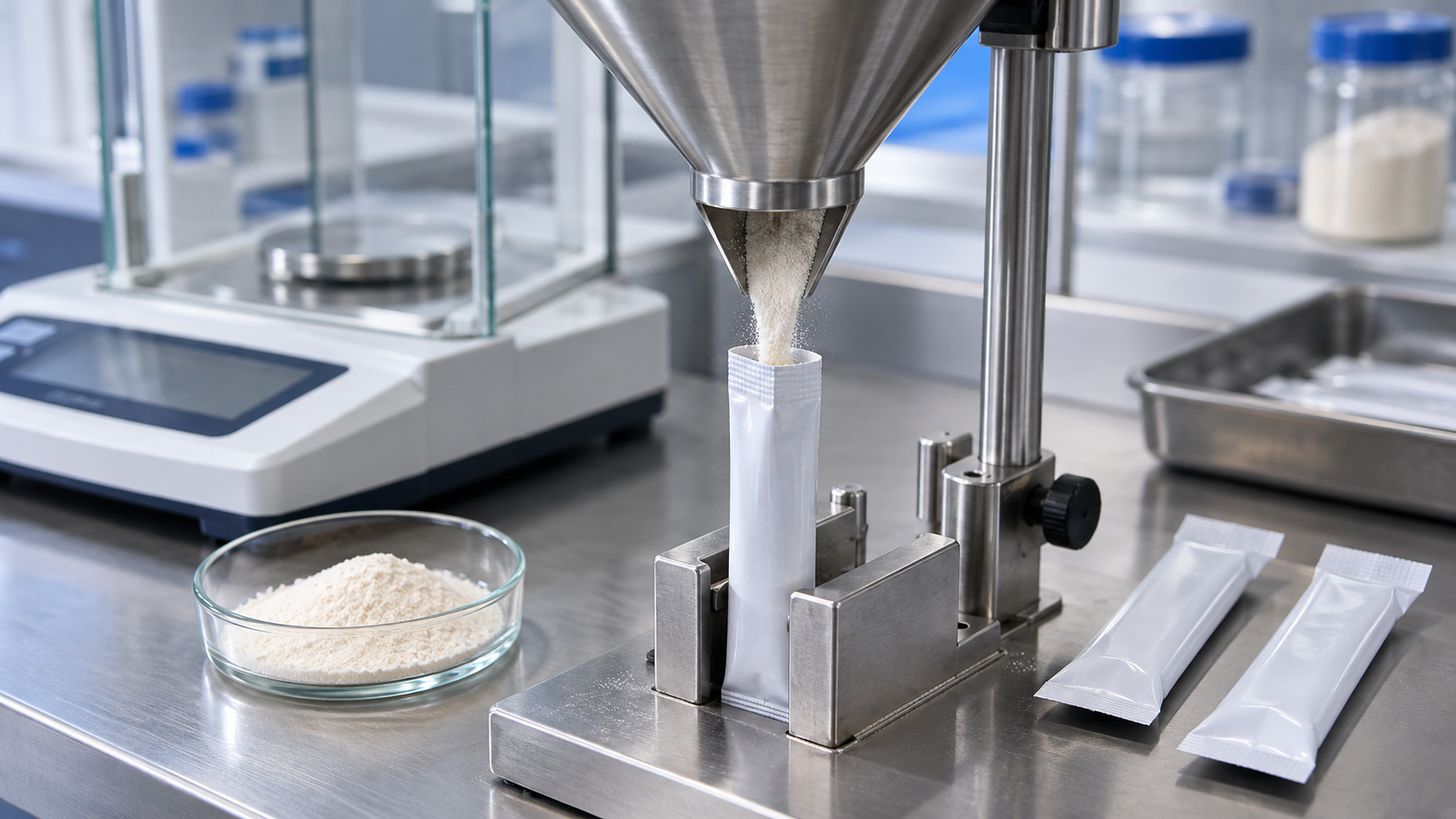
A pilot run should test the complete blend at realistic line conditions, not only a small bench sample.
| ● Achievable fill weight and sachet dimensions | ● Blend and serving-level uniformity |
| ● Flow at the intended line speed | ● Seal integrity and moisture protection |
| ● Finished-product content at release | ● Content through the planned shelf life |
DESTINATION MARKET
One Stick Pack, Every Market? Not So Fast
In the European Union, Directive 2002/46/EC establishes permitted vitamins, minerals and source forms for food supplements, while national requirements can still affect maximum levels, notifications and labelling. In the United States, dietary-supplement manufacturers must work within applicable federal requirements, including current good manufacturing practice under 21 CFR Part 111.
This is especially important when a mineral sachet sits between familiar categories such as an electrolyte drink mix, a daily supplement and a flavoured beverage powder. The consumer use occasion may be similar, but the regulatory route may not be.
Practical point
Product classification, permitted forms, claims and label wording should be reviewed for each destination rather than copied from one market to another.
DEVELOPMENT BRIEF
Design the Formula Before the Artwork
The most useful supplier brief is not a finished pouch design. It is the target elemental dose, total serving weight, preparation volume, use occasion and destination market. Those details allow the ingredient grade and its documentation to be assessed before artwork, claims and pack dimensions become expensive to change.
SRS Nutrition Express can provide grade specifications, representative COAs, assay information and samples for selected mineral ingredients, including magnesium bisglycinate. These materials help narrow the trial options. They do not replace blend testing, line validation or finished-product stability work in the intended packaging.
| 01 | Target elemental dose |
| 02 | Total serving weight |
| 03 | Preparation volume |
| 04 | Use occasion |
| 05 | Destination market |
EVIDENCE BOUNDARIES
Do Not Let the New Story Outrun the Evidence
- Demand for portable formats does not prove that every mineral combination is necessary or effective.
- A raw-material assay does not establish the mineral content of a finished sachet.
- Taste, flow and stability depend on the complete formulation and packaging.
- Permitted forms, claims and notification requirements vary by market and may change.
Planning a Mineral Stick Pack?
Share the target elemental dose, serving weight, product application and destination market. SRS can provide relevant ingredient specifications, representative COAs and sample options for formulation trials.
Recommended Reading
Can One Raw-Material Specification Work for Every Finished Product?
References
- European Parliament and Council. Directive 2002/46/EC on food supplements, consolidated text.
- Electronic Code of Federal Regulations. 21 CFR Part 111 Current Good Manufacturing Practice for Dietary Supplements.
Post time: Sep-24-2026


