

Two quotations arrive for milk thistle extract. Both products are labelled “Silymarin 80%.” One supplier uses a UV assay, while the other reports an HPLC result.
The specifications appear equivalent, but the prices—and sometimes the test results—do not.
This does not automatically mean one COA is wrong. It usually means that the two laboratories have not defined and measured “silymarin” in exactly the same way.
For buyers, Silymarin UV vs HPLC is therefore more than a laboratory question. It affects supplier comparison, incoming inspection, label claims and the risk of disputes after delivery.
1 Silymarin Is a Mixture, Not a Single Compound
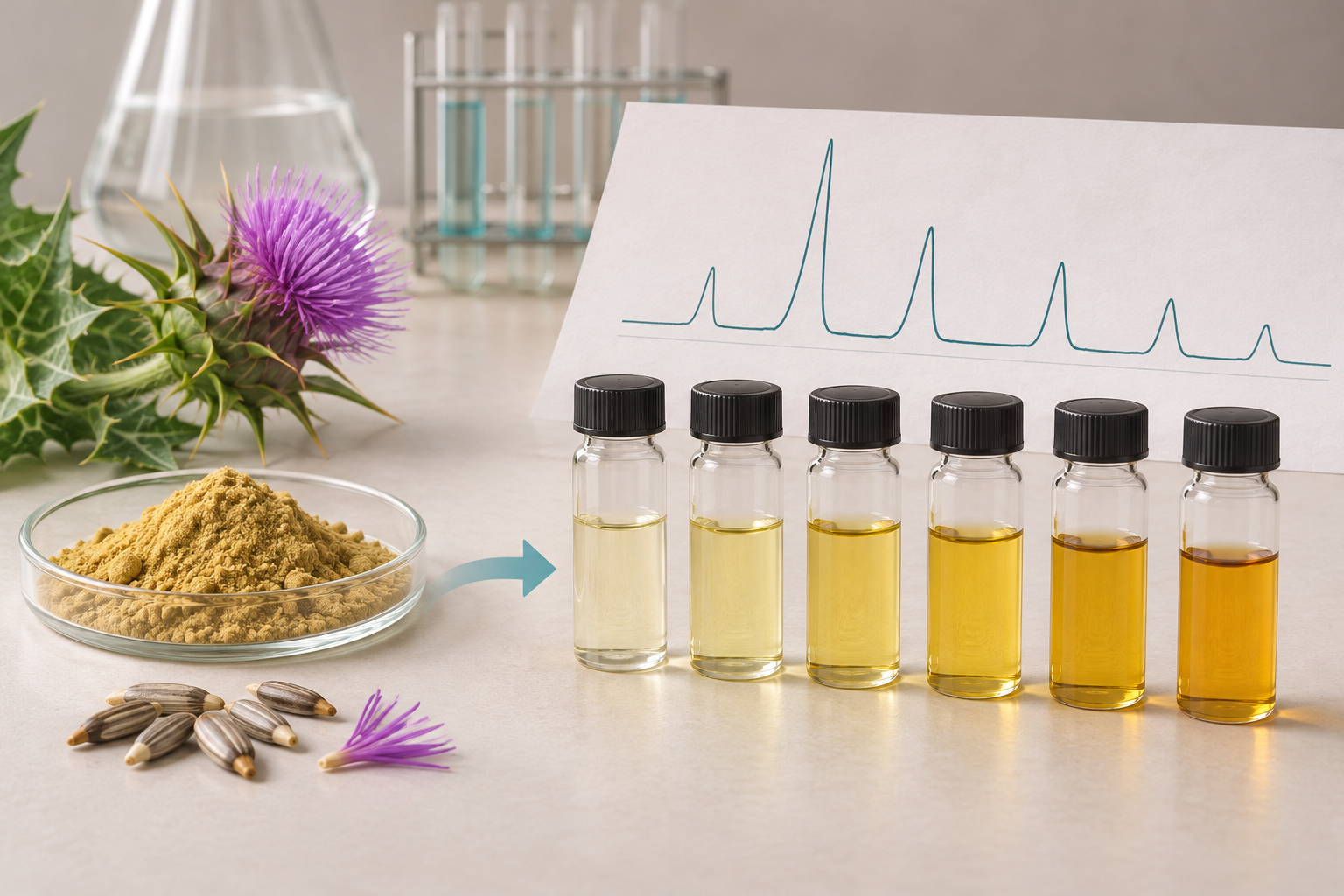
Silymarin is not one molecule. It is a mixture of related constituents from the fruit of Silybum marianum (L.) Gaertn.
Important components include:
- ✔ silybin A and silybin B;
- ✔ isosilybin A and isosilybin B;
- ✔ silychristin;
- ✔ silydianin;
- ✔ other related flavonolignans and flavonoids.
That composition matters because a test can estimate a combined response or separate and quantify selected constituents.
The current USP monograph for powdered milk thistle extract does more than verify a total labelled amount. It also defines ranges for constituent groups within total silymarin: 40–65% for silybin A and B, 10–20% for isosilybin A and B, and 20–45% for the combined silydianin and silychristin fraction.
A single percentage on a sales specification does not communicate this complete profile.
2 “UV vs HPLC” Is Useful Shorthand—but Technically Incomplete
In commercial discussions, “UV” usually refers to a non-separative spectrophotometric assay. The extract produces an absorbance response under defined test conditions, and that response is converted into a reported silymarin value using a selected reference standard or calculation.
This approach can be useful for routine testing, but other substances extracted from the sample may contribute to the measured response. Results can also depend on the extraction procedure, wavelength, reference material and calculation model.
HPLC works differently. The chromatographic system separates components before they are measured, allowing the laboratory to quantify defined peaks individually or as specified groups.
However, HPLC and UV are not true opposites. Many HPLC methods use a UV detector. For example, published USP methodology uses liquid chromatography with UV detection at 288 nm.
The more precise comparison is therefore:
- non-separative UV spectrophotometric assay; versus
- chromatographic HPLC/LC assay, often with UV detection.
3 Why Can the Same Extract Produce Different Numbers?
A difference between UV and HPLC results may come from several sources:
- different compounds included in the reported total;
- different reference standards or response factors;
- co-extractives contributing to a non-separative UV response;
- incomplete chromatographic separation or peak integration differences;
- different sample-extraction procedures;
- results reported as-is versus on a dried basis;
- differences in moisture correction;
- different pharmacopoeial or in-house methods.
Validated chromatographic research has also shown that milk thistle extracts can vary materially in their constituent profiles between manufacturers and batches. Even within a chromatographic method, matrix interference can affect particular UV-detected components if separation is inadequate.
Neither method name alone proves that a result is correct. The full method and reporting basis must be reviewed.
4 Can 80% UV Be Converted Into an HPLC Result?
There is no reliable universal conversion formula.
An “80% by UV” extract might produce a lower, similar or occasionally higher result under a particular HPLC method. The outcome depends on what generated the original UV response and which constituents the chromatographic method includes.
Applying a fixed deduction—such as assuming that every 80% UV product equals a particular HPLC percentage—would ignore differences in extraction, constituent profile and analytical procedure.
If an HPLC specification is required, the proposed commercial grade should be tested using that exact method. A calculation based only on its UV result is not sufficient.
5 What Should Buyers Request Before Comparing Quotations?
A useful milk thistle extract RFQ should identify:
- botanical name and plant part
- extraction solvent
- extract ratio
- target silymarin content
- required assay method
- constituents included
- reference standard
- dried-basis reporting
- moisture method
- carriers or excipients
Ask for actual batch results rather than “Conforms” alone. If a supplier reports 80% silymarin, the COA should make clear whether that value was obtained by non-separative UV spectrophotometry, HPLC or another defined procedure.
Reviewing a Milk Thistle Extract With SRS
The right specification depends on the intended product, market and claim—not simply on choosing the highest percentage shown on a COA.
Share your target silymarin content, required analytical method, dosage form, destination market and annual volume with SRS Nutrition Express. We can provide available grade specifications, representative batch COAs and samples, and review whether the proposed analytical basis matches your purchasing requirement.
Where comparison testing is required, the UV and HPLC methods should be aligned before commercial approval. This helps prevent an apparently compliant shipment from producing an unexpected result during incoming inspection.
Evidence Boundaries
- “80% UV” and “80% HPLC” are not automatically equivalent specifications.
- HPLC commonly uses UV detection; the important distinction is chromatographic separation.
- A higher assay number does not by itself prove better identity, consistency or application performance.
- Pharmacopoeial requirements apply only when the relevant monograph, material definition and method are applicable.
- Research on milk thistle extracts does not validate every commercial SRS or third-party batch.
- Final suitability requires review of the commercial lot, applicable specification and destination-market requirements.
Recommended Reading
- → COA vs Ingredient Qualification: Why One Document Is Not Enough
- → Can One Raw-Material Specification Work for Every Finished Product?
References
- United States Pharmacopeia. Powdered Milk Thistle Extract. USP–NF. DOI: 10.31003/USPNF_M54066_05_01.
- Wallace SN, Carrier DJ, Clausen EC. Optimization and single-laboratory validation of a method for the determination of flavonolignans in milk thistle seeds by HPLC with ultraviolet detection. Analytical and Bioanalytical Chemistry. 2015.
- Chambers CS, Holečková V, Petrásková L, et al. A validated UHPLC-tandem mass spectrometry method for quantitative analysis of flavonolignans in milk thistle extracts. Journal of Pharmaceutical and Biomedical Analysis. 2015.
- European Medicines Agency. Assessment Report on Silybum marianum (L.) Gaertn., Fructus. EMA/HMPC/294188/2013.
Post time: Nov-12-2026


