

A taurine COA reports an assay of 100.4%. The immediate reaction is understandable: how can a material contain more than 100% taurine?
The result does not necessarily mean extra taurine appeared in the sample, nor does it automatically prove that the laboratory made a mistake.
1 Some Taurine Specifications Intentionally Extend Above 100%
The Japanese Pharmacopoeia defines taurine, when dried, as containing 99.0%–101.0% of C₂H₇NO₃S. Its monograph uses potentiometric titration after the sample has been dried.[1]
The USP monograph uses a different range: 98.0%–102.0%, calculated on the dried basis.[2]
Therefore, a result such as 100.4% can comply with both examples. This does not mean that 100.4% is the material’s literal physical composition. It means that the analytical response, after applying the specified calculation, corresponds to 100.4% of the theoretical taurine amount under that method.
The pharmacopoeial name alone is not enough. Buyers should confirm:
- ✔ the pharmacopoeia and edition;
- ✔ the acceptance range;
- ✔ the analytical method;
- ✔ whether the result is reported as-is or on a dried basis.
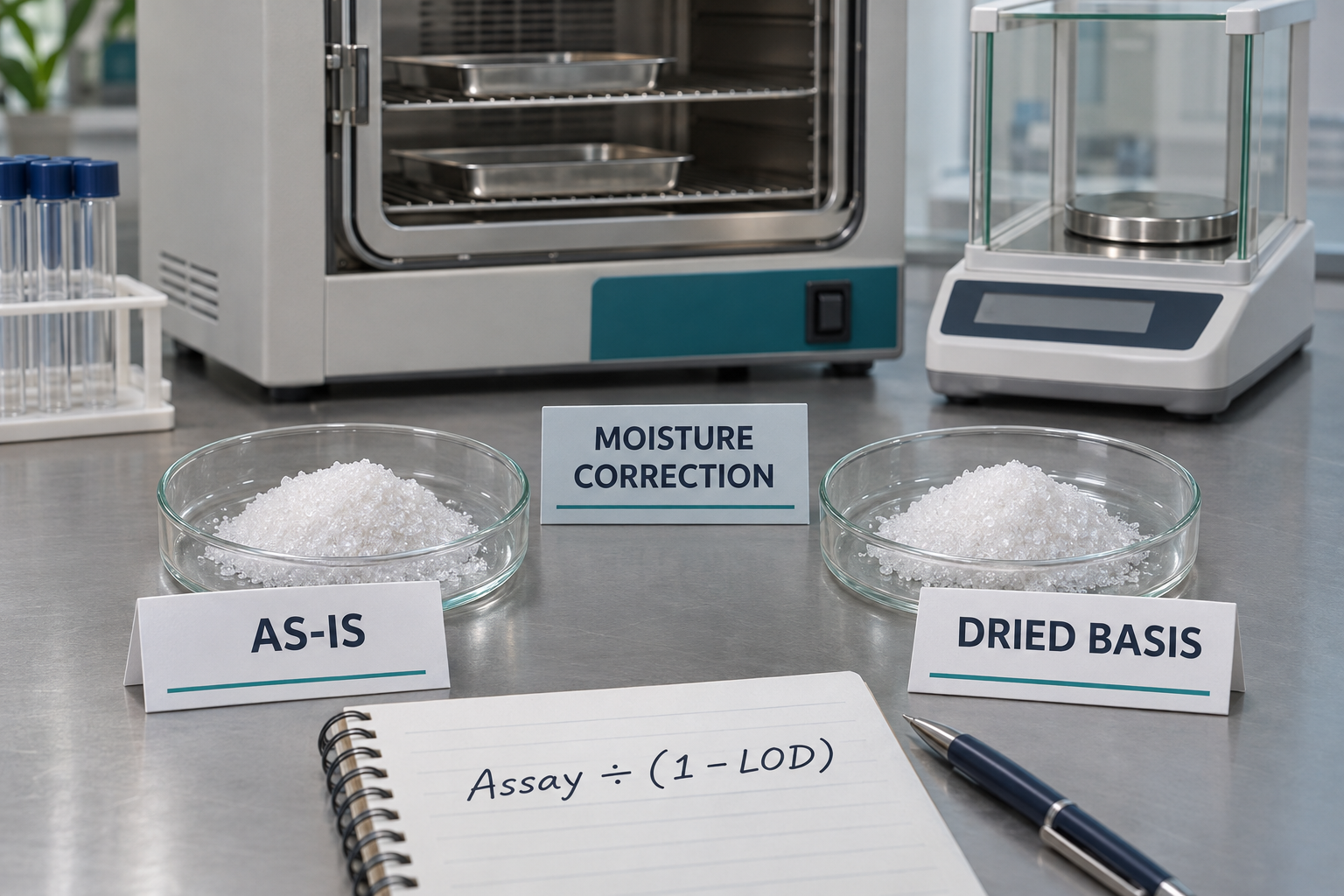
2 “As-Is” and “Dried Basis” Are Not the Same Result
An as-is result relates the measured taurine to the sample in the condition received, including its measurable moisture or volatile loss.
A dried-basis result mathematically removes that contribution.
A simplified conversion is:
Dried-basis assay = As-is assay ÷ (1 − loss on drying)
If a sample reports:
- as-is assay: 99.9%;
- loss on drying: 0.15%;
the calculated dried-basis result is approximately:
99.9 ÷ 0.9985 = 100.05%
The calculation has not created more taurine. It has changed the reporting basis.
This is why two laboratories can test the same lot and report slightly different numbers if one result is as-is and the other is corrected to dried basis.
3 The Test Method Also Changes What the Number Means
The JP monograph uses potentiometric titration. The current USP monograph describes a chromatographic procedure. These methods do not generate results through the same measurement principle.
A titration measures the response associated with a chemical reaction under defined conditions. A chromatographic assay separates and quantifies taurine relative to a reference standard.
The result can be influenced by:
- sample and standard weighing;
- reference-standard potency;
- volumetric preparation;
- titrant standardisation;
- instrument calibration;
- endpoint or peak integration;
- blank correction;
- moisture correction;
- rounding and significant figures.
This does not make assay data unreliable. It explains why a properly controlled result is still a measurement rather than a perfect count of every molecule.
Methods should not be treated as interchangeable merely because both results are expressed as a percentage.
4 Measurement Uncertainty Does Not Mean “Anything Passes”
Every quantitative laboratory result has measurement uncertainty. Eurachem notes that analytical results cannot be interpreted correctly without some understanding of the associated uncertainty.[3]
However, uncertainty should not be used after the result is known as a convenient explanation for failure.
A result of 100.4% against a 99.0%–101.0% specification may be acceptable. A result of 103.0% is outside that range and requires investigation. The laboratory should review the method, calculations, standardisation, sample preparation and original data before deciding whether retesting is justified.
Repeated testing until one result passes is not a scientifically defensible approach.
What Should Buyers Check on the COA?
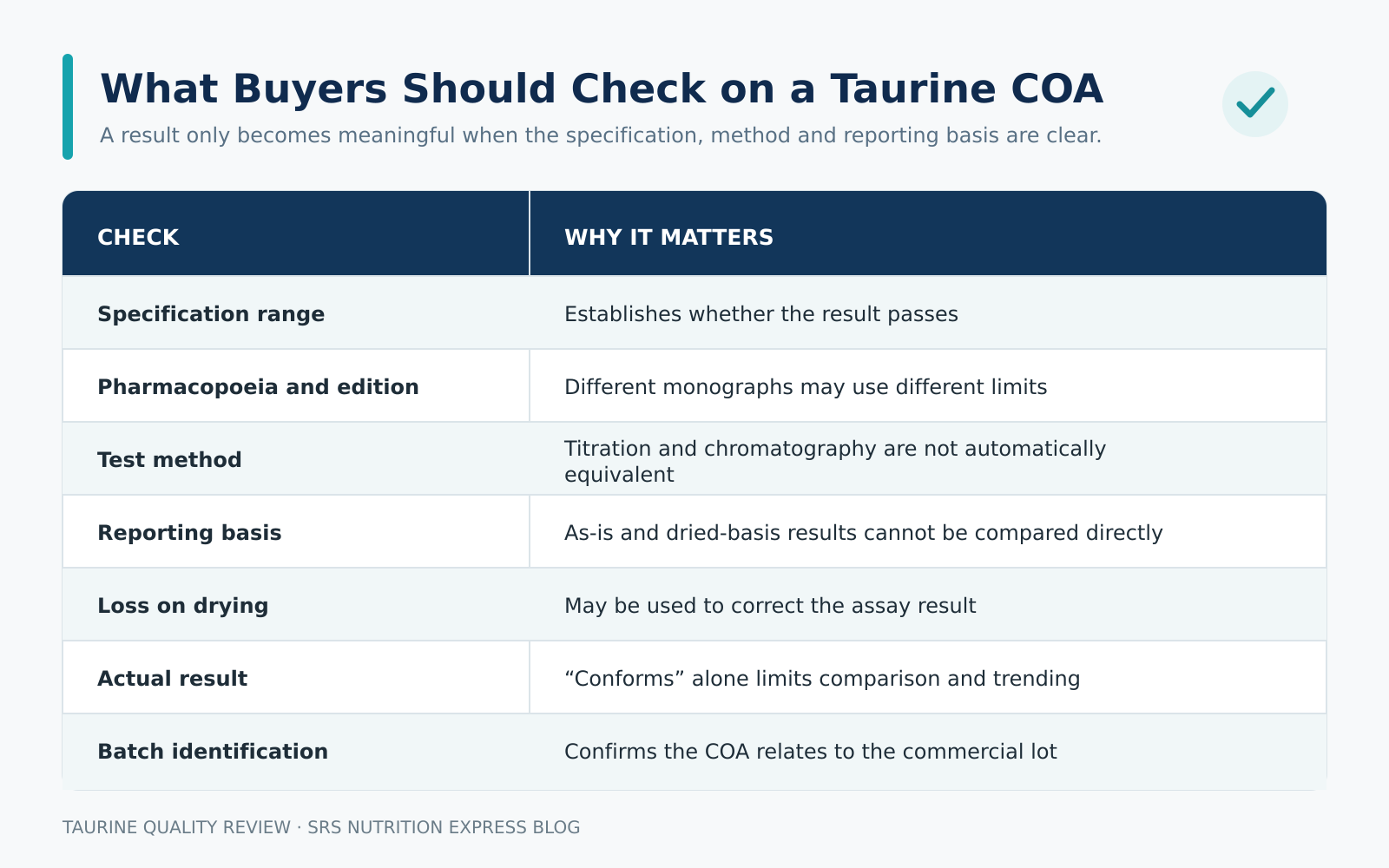
For US dietary supplements, a supplier COA used to support component specifications should include the methods, limits and actual results. The manufacturer must first establish and periodically reconfirm the reliability of the supplier’s COA.[4]
When Should a Result Trigger an Investigation?
Further review is appropriate when:
- the result exceeds the approved upper limit;
- the specification and method do not match the purchase agreement;
- dried-basis correction is not documented;
- different COA pages use inconsistent units or bases;
- the result differs materially from historical batch trends;
- the buyer’s laboratory and supplier report incompatible results.
The review should compare raw data and calculation bases before assuming that either laboratory is wrong.
Qualifying a Taurine Grade?
SRS Nutrition Express can provide available taurine specifications, commercial-lot COAs, method information and representative samples for qualification or laboratory comparison.
Share your required pharmacopoeia, assay range, reporting basis, destination market, dosage form and annual volume. SRS can help align the proposed material and documentation with your purchasing specification before commercial approval.
Evidence Boundaries
- A result above 100% is not automatically erroneous, but it must remain within the approved specification.
- Dried-basis correction can increase the reported percentage without increasing the physical quantity of taurine.
- Different pharmacopoeial methods and limits should not be combined selectively.
- Measurement uncertainty does not automatically convert a failing result into a passing result.
- A supplier COA supports qualification but does not replace the buyer’s quality responsibilities.
Recommended Reading
- COA vs Ingredient Qualification: Why One Document Is Not Enough
- Can One Raw-Material Specification Work for Every Finished Product?
- How to Investigate an Out-of-Specification Creatine Result?
References
- Pharmaceuticals and Medical Devices Agency. Japanese Pharmacopoeia, Taurine Monograph. Taurine, when dried: 99.0%–101.0%. https://jpdb.nihs.go.jp/jp/DetailList_en?keyword=Taurine
- United States Pharmacopeia. USP–NF Monograph: Taurine. NLT 98.0% and NMT 102.0%, calculated on the dried basis. https://doi.org/10.31003/USPNF_M80540_07_01
- Eurachem. Quantifying Uncertainty in Analytical Measurement. https://www.eurachem.org/index.php/tskmu
- Electronic Code of Federal Regulations. 21 CFR §§111.70 and 111.75. https://www.ecfr.gov/current/title-21/chapter-I/subchapter-B/part-111
Post time: Nov-11-2026


