

A taurine COA showing a 99% assay looks reassuring. But that number means little unless the test method, reporting basis, acceptance range and other purity controls are also clear.
Taurine is used in energy drinks, sports powders, capsules and other nutrition products. Two suppliers may offer the same chemical name and both report results around 99%, yet test against different specifications or calculate the result differently.
For buyers, the important question is not simply whether the assay passed. It is whether the result answers the requirements of the intended product and market.
A 99% Taurine Result Needs a Method and Reporting Basis
The Japanese Pharmacopoeia specifies that taurine, when dried, contains 99.0%–101.0% of C₂H₇NO₃S. Its monograph uses potentiometric titration after drying and separately controls identity, pH, related substances, loss on drying and residue on ignition. mhlw.go.jp
The phrase “when dried” matters. A result reported on a dried basis has been corrected for moisture or loss on drying. An as-is result describes the material in its tested condition. The two figures should not be compared without understanding the calculation.
Other recognised specifications use different requirements. JECFA’s flavouring specification, for example, lists a minimum assay of 98% and uses its own identification framework. JECFA
This does not make one result correct and another incorrect. It means the COA must identify which specification, edition, method and reporting basis apply.
Assay Does Not Confirm Identity
Assay estimates how much of a measured substance is present. Identity testing asks whether the material is actually taurine.
The JP monograph uses infrared spectroscopy for identification and treats assay as a separate test. That distinction is important because a non-specific quantitative result cannot always exclude another substance that behaves similarly under the test conditions.
A complete qualification review should therefore examine:
- ✓ the taurine identity method;
- ✓ the assay method and acceptance range;
- ✓ whether the result is as-is or on a dried basis;
- ✓ loss on drying or moisture;
- ✓ related substances and inorganic residue;
- ✓ applicable contaminant and microbiological controls.
A high assay should not be used as shorthand for complete purity, market compliance or suitability for a finished product.

“Conforms to JP” Still Requires Interpretation
A COA may state “Conforms to JP” without showing whether every monograph test was performed on the commercial lot or whether some results were based on supplier qualification, periodic testing or another control program.
Buyers should confirm the applicable pharmacopoeial edition and request actual numerical results where those results are important for comparison or trend analysis.
Food and dietary-supplement requirements may also extend beyond a pharmacopoeial monograph. Depending on the destination market and product format, the approved specification may need individual limits for lead, cadmium, arsenic and mercury, microbiological criteria, residual-solvent information, allergen statements and GMO documentation.
These requirements should be defined by the buyer’s regulatory and quality teams rather than copied from an unrelated product dossier.
FDA GRAS Information Is Not a Universal Taurine Standard
FDA GRAS Notice 586 evaluated a specified taurine material for use in particular noncarbonated, flavoured water-based beverages at 0.0045%. The notice described material meeting Food Chemicals Codex specifications, including a 98.5%–101.5% purity range.
FDA issued a “no questions” response regarding the notifier’s GRAS conclusion under those intended conditions of use. FDA also stated that it had not independently made a general GRAS determination for taurine. FDA
These values provide useful context, but they are not an FDA specification automatically governing every taurine supplier, dietary supplement or finished product.
Two Compliant Taurine Grades May Perform Differently
Chemical compliance does not guarantee identical processing behaviour.
Two taurine grades can meet their respective assay and purity requirements while differing in particle-size distribution, bulk density, crystal habit, flow or dissolution behaviour. These differences may influence:
- feeding and dust generation;
- capsule weight consistency;
- tablet compression;
- blend uniformity;
- dissolution in beverage premixes;
- packaging volume and line performance.
The relevant physical attributes depend on the dosage form. A beverage manufacturer may prioritise dissolution and clarity, while a tablet producer may need compression trials. Mesh terminology alone is not enough to predict either result.
What Should Buyers Request Before Approval?
A practical taurine qualification package should include:
- product name, grade, product code and manufacturing site;
- current specification and representative COA;
- compendial edition where compliance is claimed;
- identity and assay methods;
- assay basis and actual lot result;
- relevant purity and contaminant controls;
- packaging, storage and shelf-life or retest information;
- representative sample for application testing;
- change-notification and complaint-support procedures.
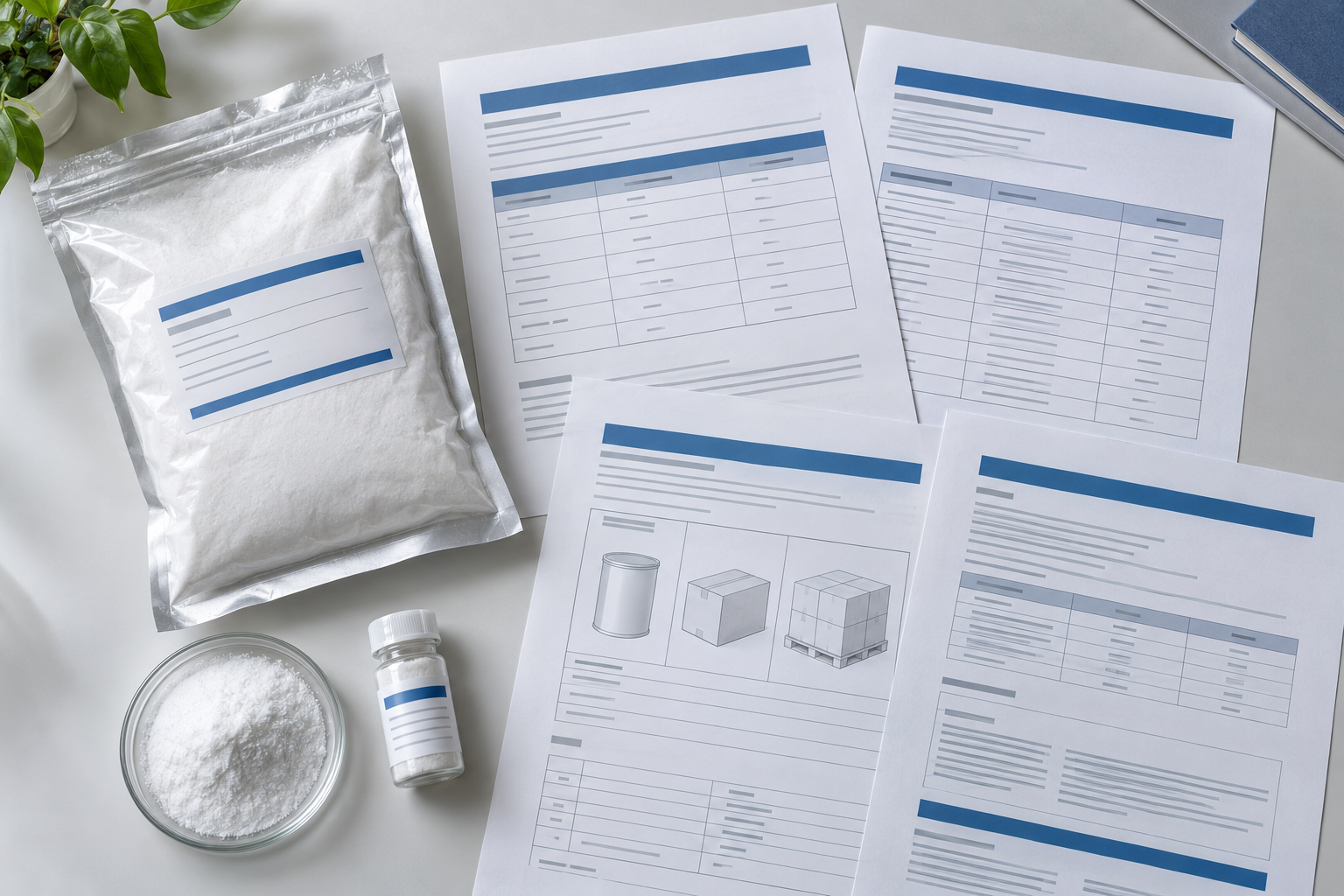
A representative COA demonstrates how results are normally reported. It does not prove that a future commercial batch has already passed. Lot-specific documentation should still be reviewed before release.
Qualifying Taurine for a New Product
Before placing a commercial order, compare a representative sample with the proposed specification and intended formulation.
Confirm whether the powder feeds, dissolves or compresses as required. If a narrow particle size, density or dissolution characteristic is commercially important, determine whether it can be specified and routinely controlled instead of relying on one sample.
SRS Nutrition Express can provide available taurine specifications, representative COAs and qualification samples for technical review. Share the dosage form, target dose, destination market, required compendial basis and expected annual volume so the proposed grade can be assessed against the finished-product brief.
Evidence Boundaries
- A pharmacopoeial specification is not automatically the legal requirement for every food or supplement market.
- A 99% assay does not independently establish identity, impurity control or finished-product suitability.
- A representative COA does not confirm the status of a future commercial lot.
- FDA GRAS notices are notifier- and use-specific; they are not blanket approvals for every taurine product.
- Raw-material qualification does not replace finished-product testing or regulatory review.
Recommended Reading
References
- Ministry of Health, Labour and Welfare, Japan. The Japanese Pharmacopoeia, Eighteenth Edition: Taurine Monograph.
- FAO/WHO JECFA. Taurine, JECFA No. 1435; Specifications for Flavourings.
- U.S. Food and Drug Administration. GRAS Notice No. 586: Taurine and FDA Agency Response Letter, December 9, 2015.
Post time: Nov-02-2026


