

“Vegetable capsule” is a useful consumer description, but it is not a complete raw-material specification.
The term does not identify the shell polymer, moisture range, gelling system, processing aids, colourants, dimensional tolerances or compatibility with the proposed fill. Two capsules marketed with the same consumer-facing description may perform differently during filling and storage.
For brands and OEMs, the shell should be qualified as part of the delivery system—not treated as an interchangeable empty container.
Start With the Polymer, Not the Marketing Name
Many non-gelatin hard capsules use hypromellose, commonly known as HPMC. Others use pullulan, modified starch or another film-forming system.
These materials are not identical.
USP describes hard hypromellose shells as two-piece capsules composed of hypromellose and water. Depending on the formulation, they may also contain colourants, opacifiers, plasticisers, antimicrobial agents, sweeteners, gelling agents, surfactants or other processing aids.[1]
The USP definition for hard pullulan capsule shells similarly allows water, colourants, flavouring agents, antimicrobial agents, sweeteners and relevant processing aids in addition to pullulan.[2]
A buyer should therefore ask what the shell is made from—not simply whether it is described as vegetable or plant-based.
“Plant-Based” Does Not Automatically Establish Every Claim
The origin of the principal polymer does not independently establish that the finished shell is vegan-certified, allergen-free, non-GMO, halal, kosher or suitable for every market.
Those positions depend on the complete formulation, manufacturing controls and supporting documentation. Colourants, processing aids and coatings should be considered along with the main polymer.
For US dietary supplements, ingredients used in the shell may also need to appear appropriately in the product’s ingredient declaration. FDA gives gelatin, starch, stabilisers, preservatives and flavours as examples of ingredients that may appear under “Other Ingredients.”[3]
Marketing language and technical documentation should therefore tell the same story.
Humidity Can Change Capsule Performance
Hard capsule shells are hydrophilic films. Their mechanical behaviour changes as they gain or lose water.
A 2020 comparative study evaluated size 0 gelatin, HPMC and pullulan capsules. Under the tested conditions, HPMC capsules showed lower moisture-sorption rates, lower equilibrium moisture content and weaker moisture-retention behaviour than pullulan or gelatin shells. Pullulan showed lower moisture sorption than gelatin but similar moisture retention.[4]
These findings help explain why different shell systems may respond differently to storage and hygroscopic fills. They do not prove that one material is universally superior.
At low humidity, moisture loss can increase brittleness in some shells. High humidity can cause softening, swelling or dimensional change. The fill can also alter the shell environment: a hygroscopic powder may draw water from the shell, while a moist blend may transfer water into it.
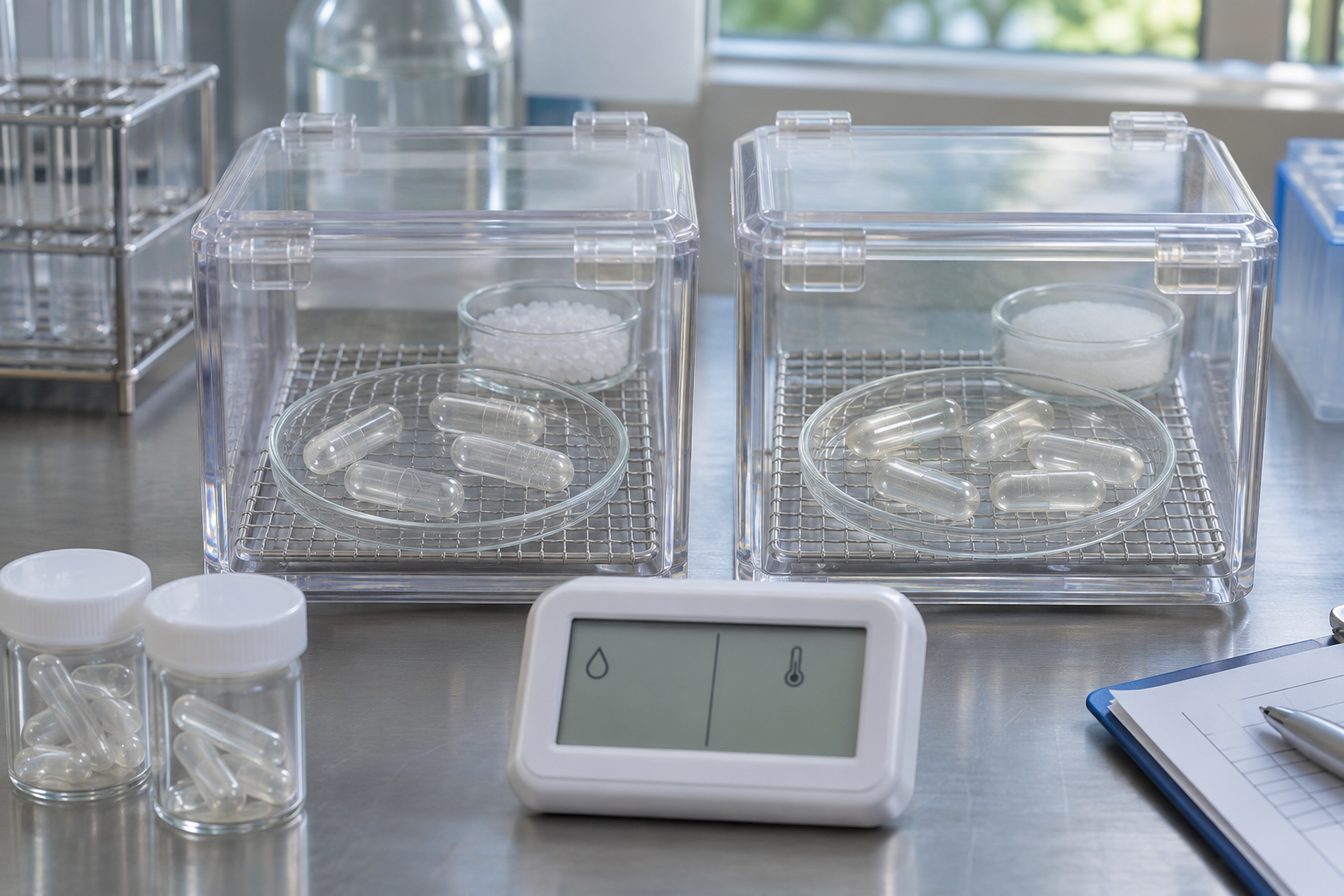
The approved storage range should come from the applicable shell specification and supplier instructions rather than a generic rule for all “vegetable capsules.”
The Fill Can Change the Shell
Capsule compatibility is a two-way interaction.
A hygroscopic powder may increase shell brittleness. A fill containing available moisture may soften the shell or affect dimensions. Oils, solvents, aldehyde-containing ingredients and reactive excipients can create different risks from a dry amino-acid powder.
Compatibility testing should use the complete commercial blend, including excipients, rather than the active ingredient alone.
During stability, inspect for:
- cracks and edge damage;
- dents or deformation;
- cap-and-body separation;
- incomplete locking or telescoping;
- leakage or powder escape;
- colour or opacity changes;
- changes in disintegration;
- interactions with the bottle, blister or desiccant.
A desiccant should not automatically be assumed to improve every capsule product. An excessively dry package environment may create problems for a moisture-dependent shell.
Capsule Size Does Not Guarantee Fill Weight
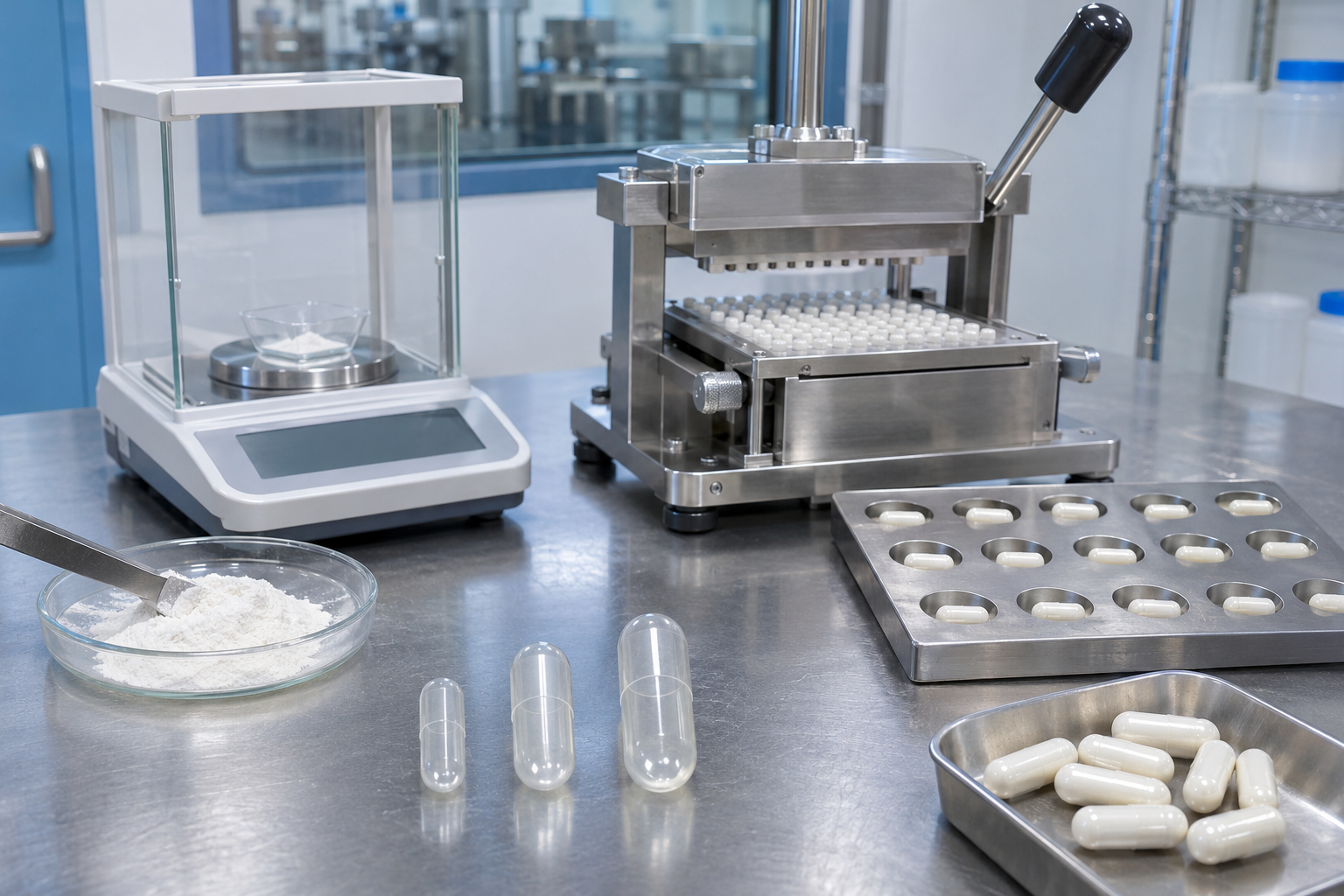
A size 000, 00 or 0 designation describes nominal capsule geometry and internal volume. It does not state how many milligrams of creatine, magnesium bisglycinate or another powder will fit consistently.
Achievable fill weight depends on:
- loose and tapped density;
- particle-size distribution;
- powder flow and cohesion;
- machine type and settings;
- tamping or dosator consolidation;
- excipients and lubricant level;
- powder-bed height and production speed.
A supplier capacity chart is useful for early planning, but it is not a production guarantee.
The proposed shell and commercial blend should be evaluated together on the intended filling equipment. This is especially important when the label concept depends on a narrow target weight or low capsule count.
What Should a Vegetable Capsule Specification Include?
A useful specification and qualification package should identify:
- shell polymer and relevant formulation system;
- additives, gelling agents and processing aids;
- capsule size and cap/body dimensions;
- locking system and dimensional tolerances;
- colour, opacity and printing requirements;
- moisture range and storage conditions;
- applicable disintegration or performance testing;
- microbiological and contaminant criteria;
- allergen, GMO, vegan, halal and kosher documentation where required;
- packaging barrier and opened-pack handling instructions;
- change-notification requirements.
The COA should identify the commercial lot and report the agreed tests. A generic specification defines acceptance criteria; it does not replace lot-specific review.
A Pilot Fill Should Represent Production
Hand-filling a few shells may confirm approximate volume, but it cannot demonstrate feeding, separation, locking or rejection performance at commercial speed.
A meaningful pilot should record:
- shell breakage and deformation;
- incomplete separation or closure;
- achieved fill weight and variability;
- dust and powder leakage;
- machine interruptions and rejection rate;
- packaged-retain performance after conditioning;
- stability in the intended bottle or blister.
Changes in polymer source, colour system, gelling aid, manufacturing site or dimensional tolerance may justify new samples or another pilot run—even if the commercial capsule name remains unchanged.
Selecting Capsules for a New Formula?
SRS Nutrition Express can provide available specifications and samples for size 000, 00 and 0 vegan capsule options.
Share the fill composition, target weight, filling-machine type, destination market, colour requirement and expected storage conditions.
⚠ Evidence Boundaries
- “Vegetable” or “plant-based” does not independently prove vegan certification or market compliance.
- HPMC and pullulan moisture behaviour varies with shell formulation and test conditions.
- Nominal capsule volume cannot guarantee commercial fill weight.
- Supplier samples and capacity charts cannot replace a pilot fill.
- Research on pharmaceutical capsule systems supports general principles but does not validate every supplement formula.
Recommended Reading
References
- United States Pharmacopeia. Hard Hypromellose Capsule Shells. USP–NF.
- United States Pharmacopeia. Hard Pullulan Capsule Shells. USP–NF.
- U.S. Food and Drug Administration. Questions and Answers on Dietary Supplements: Ingredient Declaration.
- Yang N, Chen H, Jin Z, et al. Moisture sorption and desorption properties of gelatin, HPMC and pullulan hard capsules. International Journal of Biological Macromolecules. 2020;159:659–666. DOI: 10.1016/j.ijbiomac.2020.05.110.
Post time: Nov-03-2026


