

Five grams and 0.005 grams are 1,000-fold apart.
That is not label rounding. It is not ordinary laboratory variation. And it is much too large to explain with a casual “gummies are difficult.”
In 2025, supplement-testing platform SuppCo purchased five creatine powders and six creatine gummy products and sent them to an independent laboratory. All five powders met SuppCo’s criteria. Four of the six gummy samples did not pass its identity or potency assessment.
That leaves an interesting question:
If two gummies came reasonably close to their labels, why did four others contain so little creatine?
The Six Gummies Fell Into Two Very Different Groups
Two products did not merely scrape through.
Create declared 4.5 g of creatine per serving and tested at 4.59 g. Force Factor declared 5 g and tested at 6.3 g.
The other four samples told a very different story:
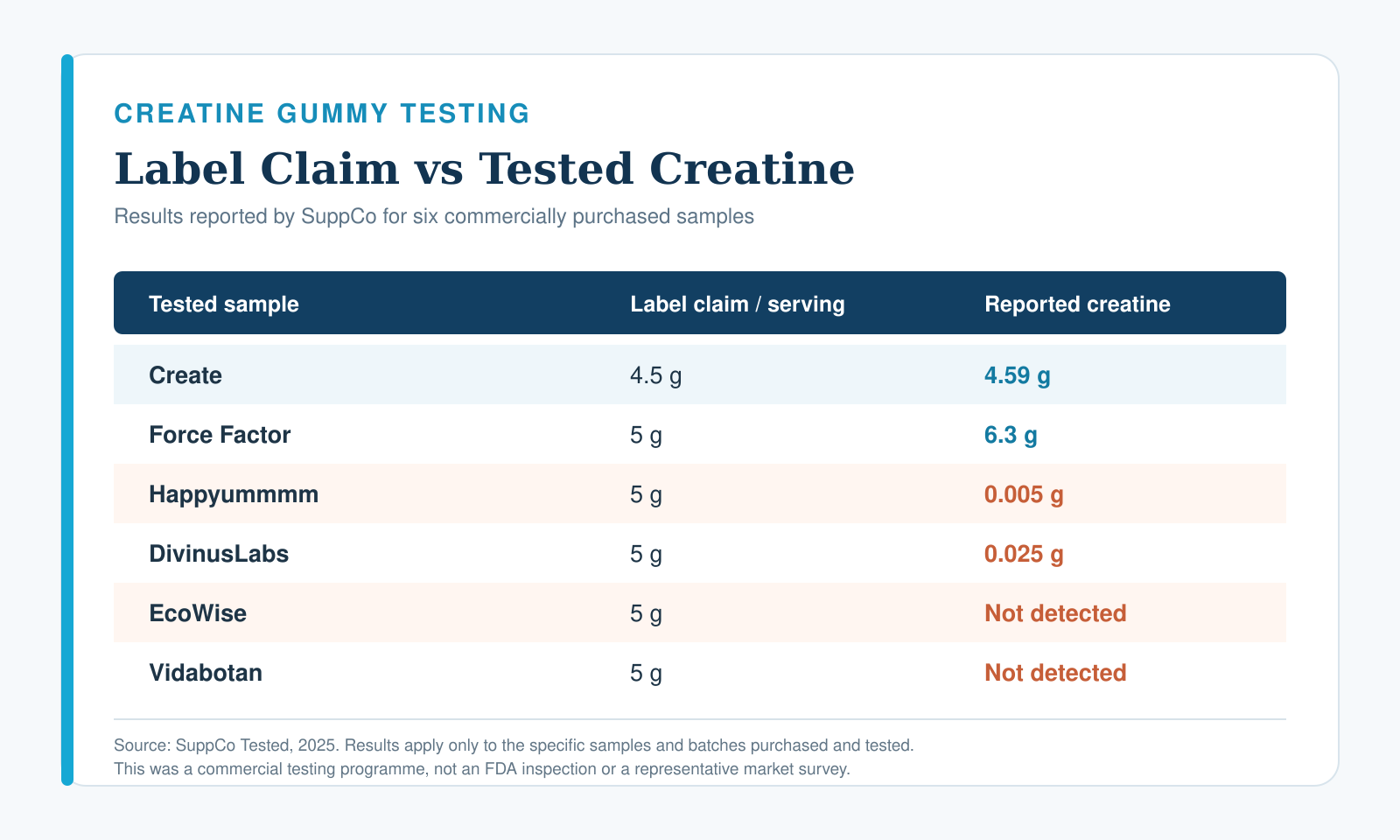
This was a commercial testing project, not an FDA market survey. The results apply only to the products and batches purchased by SuppCo. They cannot tell us how every batch from each brand would perform.
Still, the comparison rules out two easy answers.
Creatine gummies are not impossible to make: two tested samples delivered substantial amounts of creatine. But a good creatine raw material does not automatically become a good creatine gummy.
So Where Did the Creatine Go?
The honest answer is that one test result cannot tell us.
A very low result could begin with too little creatine being added. It could involve a calculation error, incomplete mixing, uneven depositing, degradation during processing or storage, or a laboratory method that struggles with the gummy matrix.
Several tested gummies also contained creatinine, a known degradation product of creatine. That makes degradation a reasonable part of the investigation—but not a complete explanation.
Finding creatinine does not show exactly when conversion occurred, and it does not necessarily account for several missing grams of creatine.
The useful question is therefore not simply:
“Is creatine unstable?”
It is:
“What happened to this particular formula, process, package and batch?”
Gummies Put Creatine Somewhere Powder Does Not
Creatine monohydrate is comparatively comfortable as a dry crystalline powder.
A gummy is a different neighbourhood.
There is water. There may be an acidic flavour system. The mixture may be heated, held, transferred and deposited before it reaches the mould. After that, it still has to remain within specification throughout storage.
Published research shows that creatine degradation can be affected by temperature and water activity. Its stability in an aqueous environment also generally decreases as acidity and temperature increase.
That does not mean every acidic gummy will fail. It means the final result depends on details that are easy to overlook:
- when the creatine is added;
- how hot the mixture is at that point;
- how long it remains hot;
- finished-product pH and water activity;
- packaging and storage conditions;
“Creatine was present on production day” is not the same as “the labelled dose will still be present near the end of shelf life.”
Five Grams Also Has to Fit Somewhere
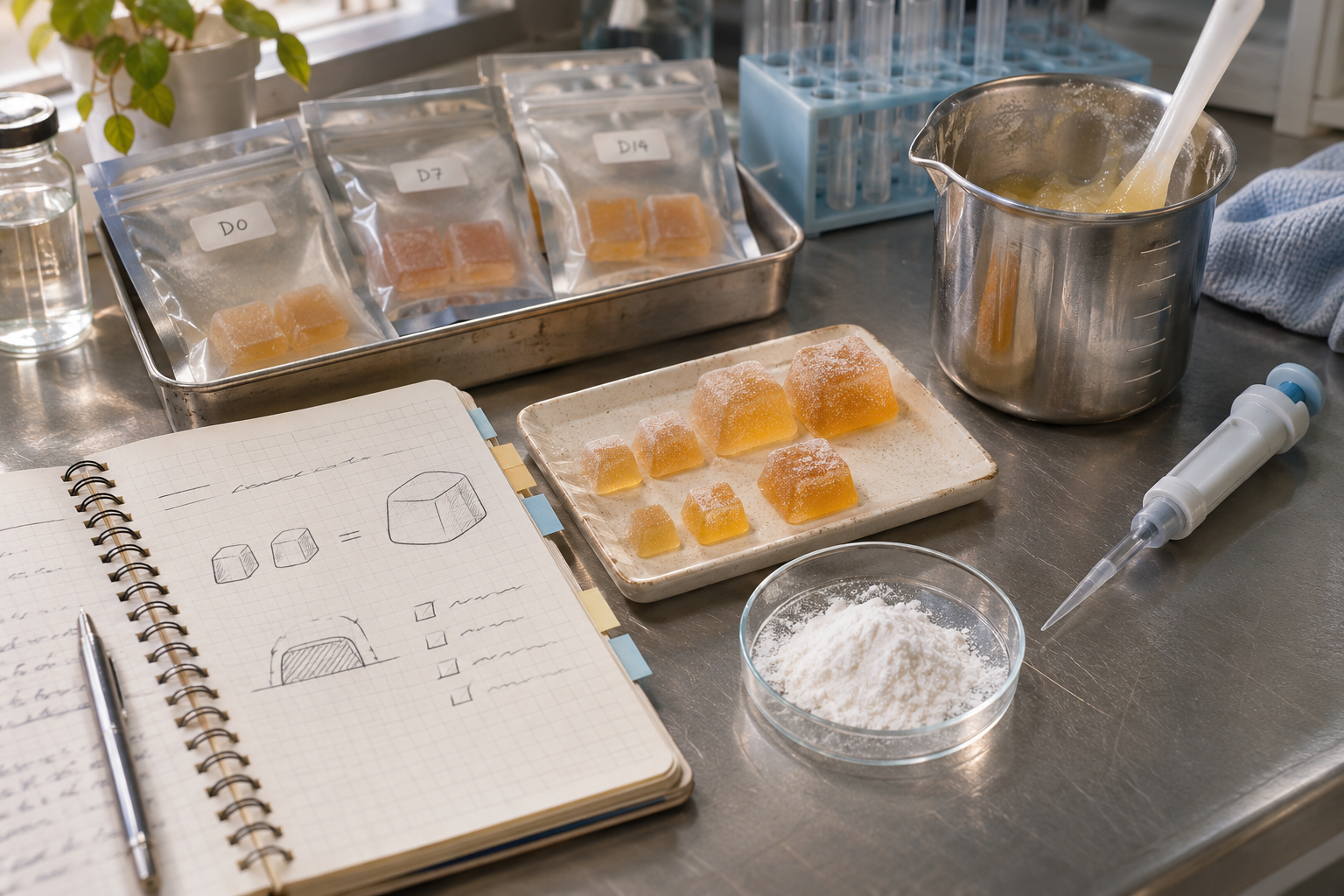
A creatine gummy does not contain creatine alone.
The gelling system, sweeteners, acids, flavours, water and other active ingredients all require space. Trying to fit 5 g of creatine into two or three gummies can quickly change their size, texture and taste.
Developers usually end up moving between three options:
- increase the number of gummies per serving;
- make each gummy larger;
- reduce the declared creatine dose.
None is automatically wrong. But each changes the consumer experience, cost per serving, bottle count and packaging size.
This is why converting a powder into a gummy is not simply a matter of sending the same formula through a different machine. The dose, gummy weight, process and package have to be reconsidered together.
The Raw-Material COA Cannot Answer the Final Question
A creatine COA can confirm what was tested in the raw-material lot. It cannot show what happened after the material entered a heated, hydrated and possibly acidic gummy system.
The question consumers ultimately care about is much simpler:
How much creatine is in the serving they actually eat?
That requires finished-product testing using a method suitable for the gummy matrix. Stability work should also use the commercial formula and intended packaging—not a different gummy or a convenient reference product.
For a new project, it helps to define the testing plan before the first commercial batch rather than after an unexpected result appears.
Developing a Creatine Gummy?
Before requesting a quotation, write down seven things:
Target creatine per serving, gummies per serving, estimated gummy weight, acid system, processing temperature, intended shelf life and packaging format.
Those details often reveal whether the initial concept is realistic—and where additional testing may be needed.
SRS Nutrition Express can provide creatine monohydrate samples, grade-specific specifications, lot documentation and available particle-size information for formulation trials. Finished-product potency and shelf-life performance must still be confirmed in the actual gummy formula.
Evidence Boundaries
- The SuppCo findings apply only to the samples and batches tested.
- A low result does not by itself identify under-dosing, degradation or analytical error.
- Creatinine may indicate conversion, but it does not explain every potency difference.
- Raw-material compliance does not prove finished-gummy potency.
- Shelf-life conclusions require testing of the commercial formula in its intended packaging.
Recommended Reading
References
- SuppCo Tested. Creatine Testing Results: Gummies Failed Lab Analysis. 2025.
- SuppCo Tested. 2025 Testing Retrospective. 2025.
- Uzzan M, Nechrebeki J, Zhou P, Labuza TP. Effect of water activity and temperature on the stability of creatine during storage. Drug Development and Industrial Pharmacy. 2009;35(8):1003–1008. DOI: 10.1080/03639040902755197.
- Kreider RB, Kalman DS, Antonio J, et al. International Society of Sports Nutrition position stand: safety and efficacy of creatine supplementation in exercise, sport, and medicine. Journal of the International Society of Sports Nutrition. 2017;14:18. DOI: 10.1186/s12970-017-0173-z.
Post time: Nov-06-2026


