

A creatine quotation may carry one company name. The Certificate of Analysis may show another. The invoice may come from a European distributor, while the material was produced and packed somewhere else.
Does that mean something is wrong?
Not necessarily.
Ingredient supply chains often involve manufacturers, milling or packing sites, laboratories, exporters, distributors and regional warehouses. One company does not have to perform every activity.
The problem begins when nobody can clearly explain who did what—or connect the creatine in your warehouse to the site and batch that produced it.
“Supplier” Can Mean Several Different Things
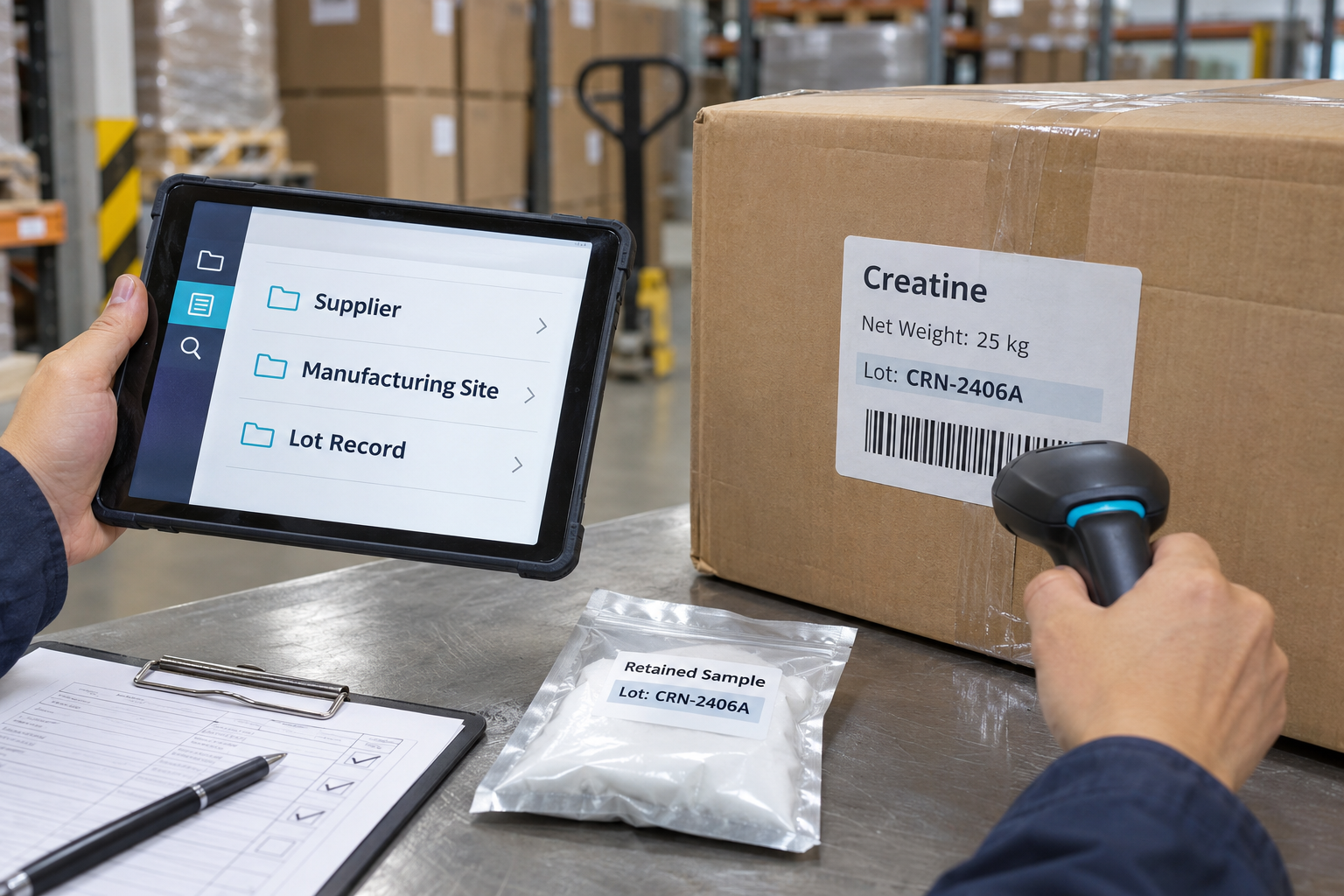
When a company says it supplies creatine monohydrate, it may be acting as:
- • the original manufacturer;
- • an authorised distributor;
- • an exporter or importer of record;
- • a regional stockholder;
- • a contract packer;
- • a private-label project coordinator;
- • or a trader purchasing from changing sources.
These models carry different risks and advantages.
A regional distributor may offer shorter lead times, local inventory and easier import arrangements. A manufacturer may provide more direct access to production information. Neither model is automatically better.
What matters is whether the commercial offer and supporting documents accurately describe the supply chain.
Start With the Manufacturing Site, Not the Logo
A polished brochure or branded specification does not identify where the material was made.
Before qualification, ask for the legal name and address of the manufacturing site. If milling, repacking or testing takes place elsewhere, those activities should also be understood.
The buyer should be able to distinguish between:
- Manufacturer: produces the creatine monohydrate.
- Processor: performs activities such as milling or particle-size adjustment.
- Packer: fills the material into commercial packaging.
- Testing laboratory: performs some or all reported analyses.
- Supplier or distributor: sells and delivers the material.
- Document issuer: assembles or signs the commercial documentation package.
One company may hold several of these roles. The important point is that the roles remain traceable rather than being presented as if they were identical.
Whose Name Should Appear on the COA?
There is no useful universal rule that every COA must display only the factory name. A manufacturer may issue the original COA, while a qualified distributor issues a customer-facing document based on linked batch records.
The better questions are:
- Does the COA identify the commercial lot?
- Can that lot be linked to the manufacturer’s production batch?
- Are the specification, methods, limits and actual results stated?
- Is it clear which organisation performed or authorised the testing?
- Has the document been altered, reformatted or reissued?
- Can the supplier provide the underlying batch information if a dispute occurs?
For US dietary-supplement manufacturing, reliance on a supplier COA for eligible component specifications requires the supplier’s reliability to be established and periodically reconfirmed. The COA must also include the methods, limits and actual results required under the applicable provisions of 21 CFR Part 111.
A logo alone does not satisfy those requirements.
Can the Delivered Lot Be Traced Back?
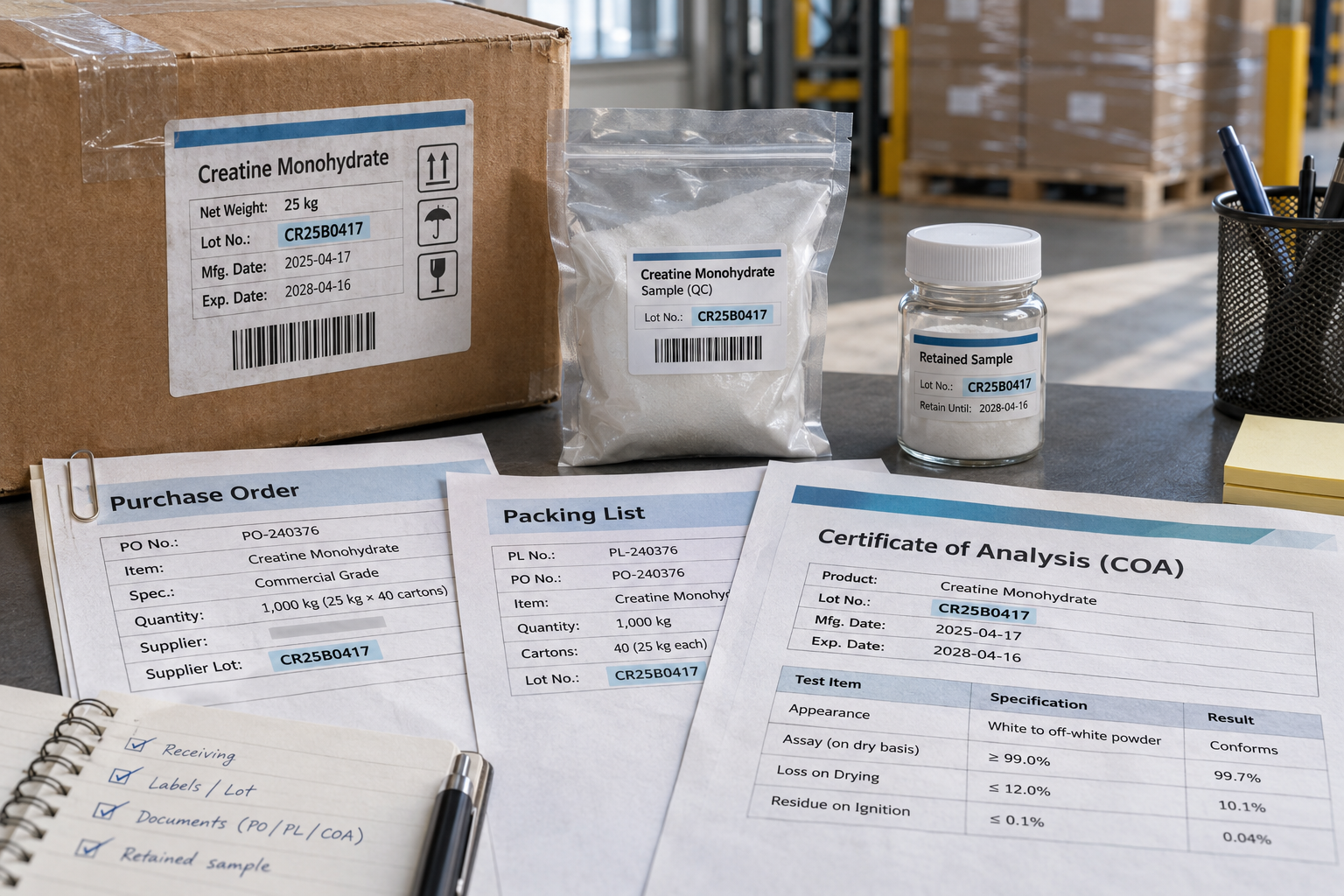
Imagine that an incoming assay fails six months after delivery. The outer label shows the distributor’s lot number, while the laboratory report uses another batch number.
Can the supplier connect them?
If the material was repacked, the records should also link the original containers to the new packaging lot.
Under US dietary-supplement CGMP requirements, received component lots must be identified in a way that allows them to be traced to the supplier, receipt date, component status and the dietary supplement in which they were used.
EU food law similarly requires traceability through production, processing and distribution, including systems that identify suppliers and business customers. EUR-Lex
Neither framework says that every organisation in the chain must be the manufacturer. Both make traceability essential.
Warning Signs Are Usually Found in the Gaps
A distributor relationship should not be rejected simply because the seller is not the factory. More useful warning signs include:
- reluctance to identify the manufacturing country or site;
- batch numbers that change between the label, COA and invoice;
- a generic COA with no connection to the delivered lot;
- manufacturing certificates belonging to an unexplained third party;
- inconsistent specifications for supposedly identical grades;
- no procedure for complaints, recalls or change notification;
- repeated changes in source without informing the buyer.
Confidentiality can limit how much commercial information is shared. It should not prevent the supplier from demonstrating control of the material being sold.
What Should Buyers Request Before Approval?
A practical qualification package may include:
- manufacturing-site name and address;
- explanation of the supplier’s role;
- current product specification;
- representative and commercial-lot COAs;
- batch-number relationship or traceability statement;
- relevant manufacturing and quality certificates;
- packing and storage information;
- change-notification and complaint contacts;
- a representative sample from the proposed grade;
- confirmation that future commercial supply will come from the qualified source.
The final item is easy to miss. A sample from one manufacturer is of limited value if the subsequent order can be filled from another source without notification.
Know Who Made the Creatine You Are Approving
SRS Nutrition Express can provide a documentation package that distinguishes the commercial supplier, document issuer and applicable manufacturing entity rather than treating them as interchangeable.
For a qualification review, share your destination market, dosage form, required grade, annual volume and documentation checklist. SRS can provide the applicable specification, representative sample, lot COA, packaging information and available manufacturing-site and traceability documentation for the proposed supply route.
Evidence Boundaries
- Purchasing from a distributor does not automatically increase product risk.
- A factory certificate does not prove that a specific delivered lot came from that factory.
- A supplier-branded COA can be acceptable only when it remains connected to controlled batch records.
- Traceability documents support qualification but do not replace identity testing, incoming controls or finished-product responsibilities.
- Required documentation depends on the market, buyer role and product category.
Recommended Reading
- Changing Creatine Suppliers? A Qualification Checklist
- What Should a Creatine Supplier Quality Agreement Include?
- COA vs Ingredient Qualification: Why One Document Is Not Enough
References
- U.S. Food and Drug Administration. Dietary Supplement Current Good Manufacturing Practices—Small Entity Compliance Guide.
- Electronic Code of Federal Regulations. 21 CFR Part 111—Dietary Supplement CGMP.
- European Parliament and Council. Regulation (EC) No 178/2002, Article 18—Traceability.
Post time: Nov-09-2026


