

Protein products for healthy aging increasingly combine whey with fermentation, vitamins, minerals or other nutritional features. A 2026 randomized trial in older Korean adults reported encouraging changes after supplementation with a lactic acid bacteria–fermented whey protein product.
The results support further investigation, but they do not show that fermented whey is superior to ordinary whey protein.
? What Did the Study Test?
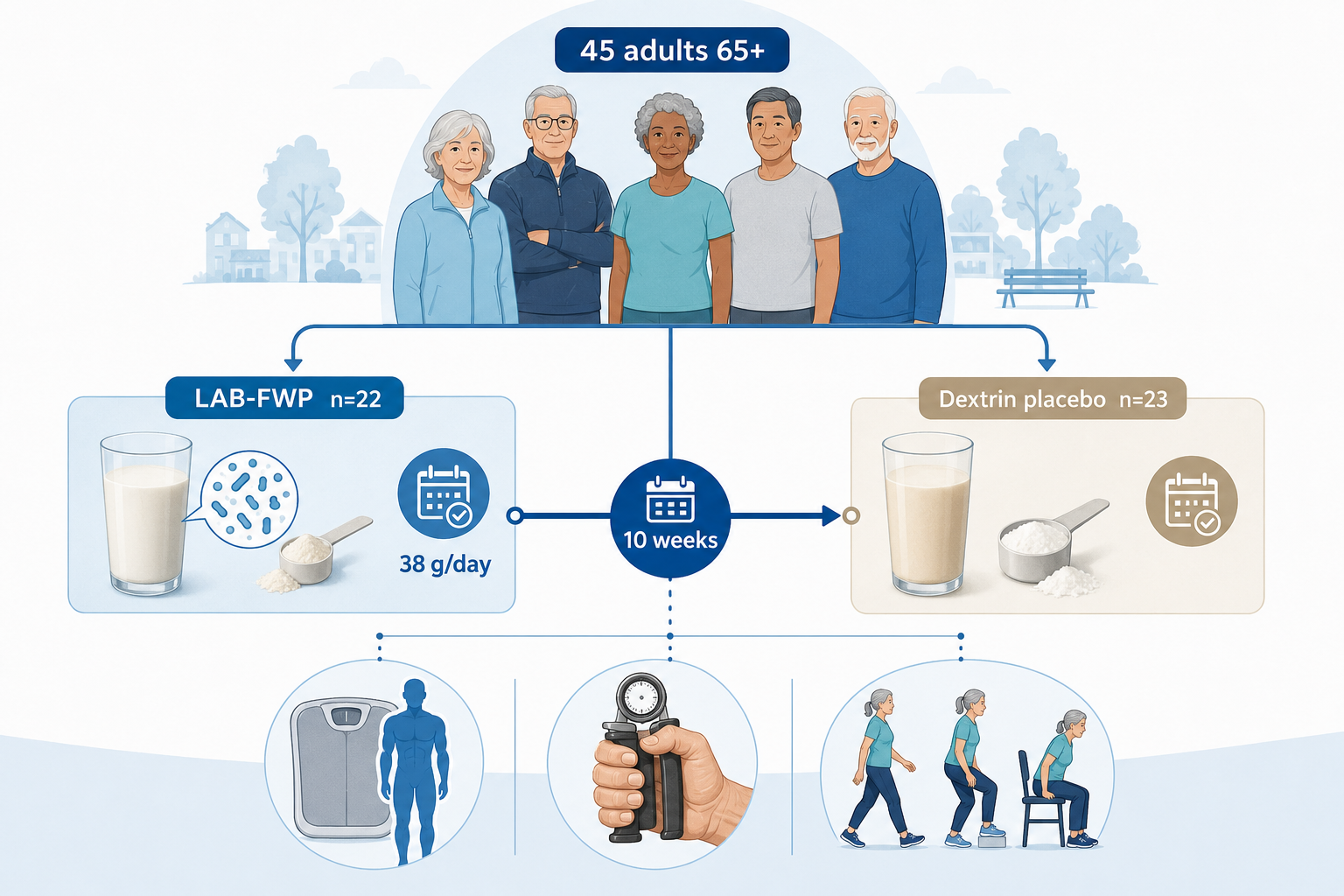
The 10-week randomized, blinded trial enrolled 45 community-dwelling Korean adults aged 65 or older. None had used protein supplements during the previous six months.
Twenty-two participants received 38 g per day of a specific lactic acid bacteria–fermented whey protein product, referred to as LAB-FWP. The remaining 23 received a taste- and texture-matched dextrin placebo.[1]
Researchers assessed body composition, handgrip strength and an electronic Short Physical Performance Battery, or eSPPB. The eSPPB evaluates functions involving balance, walking and chair-rise performance. Nutritional status and dietary intake were also assessed.
This design compared a complete protein-based supplement with a carbohydrate placebo. It did not include a non-fermented whey group, so it could not isolate the effect of fermentation.
↑ What Changed in Muscle Mass and Physical Function?
Compared with the control group, the LAB-FWP group showed a greater improvement in skeletal muscle mass index. The paper reported a between-group difference in change of 1.5, with P = .004.[1]
The intervention group also had a 1.4-point greater improvement in eSPPB score than the control group, with P = .017.[1]
Within the LAB-FWP group, eSPPB score and handgrip strength improved significantly from baseline. However, the published abstract does not report a significant between-group advantage for handgrip strength.
That distinction is important. A change within one group does not demonstrate that the intervention performed better than placebo.
The findings therefore provide a positive signal for muscle mass and physical performance over ten weeks. They do not establish that the product prevented or treated clinically diagnosed sarcopenia, or that the changes continued after supplementation ended.
+ The Intervention Changed More Than Protein Intake
During the study, reported vitamin D intake in the LAB-FWP group increased from 2.2 to 11.6 µg per day. Calcium increased from 280.9 to 566.7 mg per day, while magnesium increased from 135.5 to 316.3 mg per day. All three changes were statistically significant.[1]
These results show why the entire formulation matters. The study did not evaluate fermentation as an isolated variable. Protein, energy and the additional vitamin and mineral contribution may all have influenced the outcomes.
Without an ordinary whey comparator matched for protein, calories and micronutrients, the trial cannot tell us whether fermentation produced an independent benefit.
! What the Trial Cannot Yet Answer
The study included only 45 participants from one population and lasted ten weeks. It compared the active product with dextrin rather than an equal-protein control.
Its findings therefore cannot automatically be applied to every fermented whey ingredient, conventional WPC or WPI, or older adults with different nutritional and health backgrounds.
The trial also did not directly establish that fermentation improved protein absorption, digestive tolerance or muscle protein synthesis. Those questions would require suitable measurements and a matched non-fermented whey comparator.
★ What This Means for Healthy-Aging Product Development
The study supports continued interest in protein-based nutrition for older adults, but it makes a stronger case for evaluating complete formulations than for using “fermented” as a stand-alone benefit.
Product developers should consider:
- protein amount and quality;
- leucine and essential amino acid content;
- vitamin and mineral contribution;
- serving size and energy content;
- flavour, dispersibility and digestive tolerance; and
- whether the commercial ingredient matches the clinically tested material.
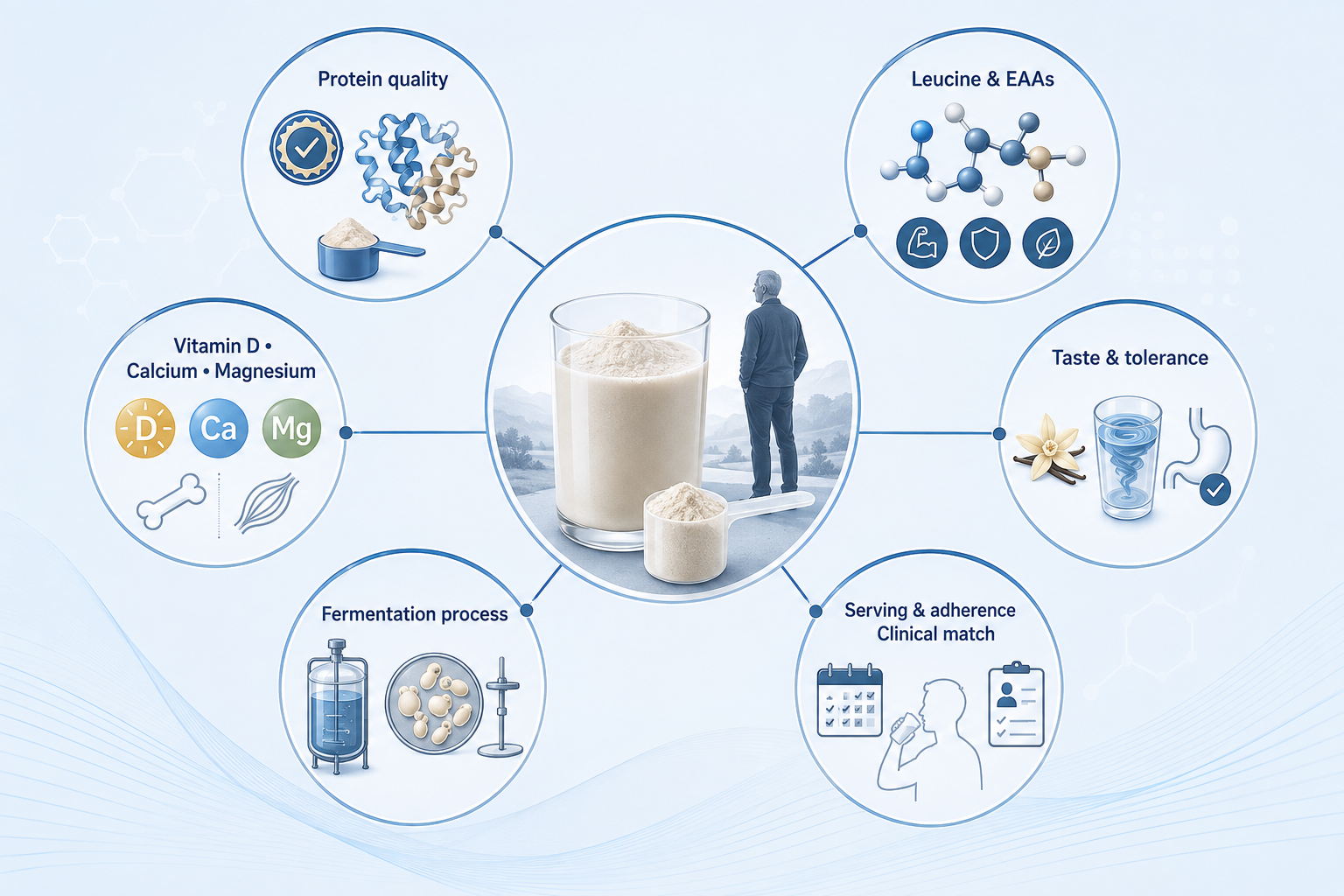
The fermentation organism, manufacturing process, resulting composition and clinical match should be documented before the research is used in product communication.
SRS Nutrition Express supports healthy-aging product development through whey protein ingredient selection, specifications, samples and formulation discussions. Evidence generated with one proprietary fermented supplement should not be presented as proof for a different raw material or finished formula.
Contact SRS Nutrition Express to discuss whey protein specifications, serving-size targets and ingredient compatibility for healthy-aging formulations.
References
- Lim HS, Jung DH, Kim HY, Lee JW, Kim YS, Shin H. Fermented Whey Protein Supplement Slows the Progression of Frailty and Sarcopenia Among Older Korean Adults: A Randomized Blinded Trial. Journal of Medicinal Food. 2026;29(4):205–213. doi: 10.1177/1096620X261430172. PubMed record.
- Bauer JM, Biolo G, Cederholm T, et al. Evidence-Based Recommendations for Optimal Dietary Protein Intake in Older People: A Position Paper From the PROT-AGE Study Group. Journal of the American Medical Directors Association. 2013;14(8):542–559.
Post time: Aug-14-2026


