

A laboratory reports a pesticide residue of 0.03 mg/kg.
To someone outside quality control, that sounds almost too small to matter. To a European pea protein buyer, it can trigger several emails, a processing-factor request and a hold on the order.
The buyer is not necessarily saying that 0.03 mg/kg is unsafe.
They are asking a different question:
Which legal limit applies to this substance in this processed ingredient—and what evidence supports the comparison?
That question cannot be answered by the number alone.
! A Small Number Is Not Automatically a Passing Number
Pesticide limits are not based on whether a result “looks low.”
The conclusion depends on:
- • the pesticide or residue definition;
- • the relevant agricultural commodity;
- • the applicable maximum residue level;
- • whether the sample is raw or processed;
- • the laboratory’s limit of quantification;
- • measurement uncertainty;
- • and the intended market.
A result of 0.03 mg/kg could be well below one applicable limit and above another. Where no specific EU MRL is established, a default value of 0.01 mg/kg commonly applies, subject to the scope and provisions of Regulation (EC) No 396/2005.
That is why “below 0.1 ppm” is not a complete pesticide specification.
Pea Protein Is Not the Same Thing as a Pea
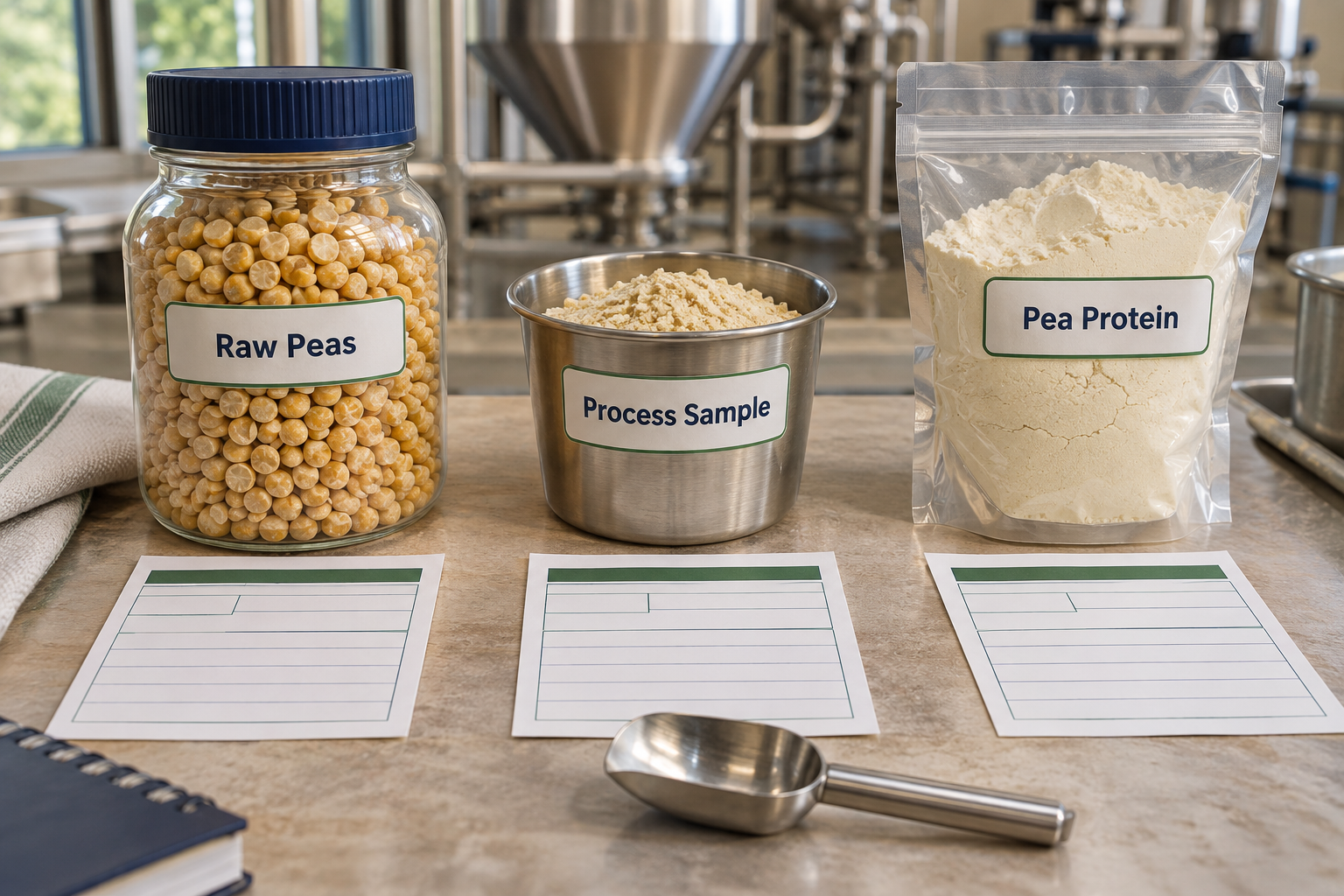
EU pesticide MRLs are generally organised around agricultural commodities listed in the legislation.
Pea protein isolate is different from the raw pea it came from. Protein separation removes some components and concentrates others. Water, starch, fibre and soluble material may leave the process, while the protein-rich fraction becomes a much smaller share of the starting material.
Residue concentration depends on:
- where the substance sits within the pea;
- whether it is water- or fat-associated;
- washing and soaking;
- pH separation;
- extraction yield;
- filtration;
- drying;
- and the definition of the final product.
EU Regulation 396/2005 states that, where a separate MRL is not established for a processed product, the relevant raw-commodity MRL should be considered together with changes caused by processing or mixing.
This is where the processing factor enters the discussion.
A Processing Factor Is Not Just the Concentration Ratio
The basic expression:
Processing factor = residue in processed product ÷ residue in raw commodity
But a defensible factor requires more than dividing two convenient numbers.
The raw peas and finished protein should come from a connected production process. The residue definition and analytical basis should match. Sampling, moisture basis, quantification limits and process yield can all affect the calculation.
A theoretical ratio such as “five kilograms of peas produce one kilogram of protein, so the factor must be five” does not establish how a particular pesticide behaves during processing.
The European Commission’s Article 20 guidance allows food-business operators to provide product- and process-specific information for consideration by competent authorities, but describes minimum information expected when a specific processing factor is proposed.
If no reliable factor is available for that pesticide and process, the uncertainty should be stated rather than hidden behind an estimated number.
What Does the “±” After a Result Mean?
A laboratory might report:
0.03 ± 0.01 mg/kg
The value after the ± sign generally relates to measurement uncertainty. It does not mean the laboratory is free to choose whichever result is more convenient.
For official enforcement, competent authorities consider analytical uncertainty when deciding whether an MRL has been exceeded. EFSA’s reporting distinguishes between samples exceeding an MRL numerically and those classified as non-compliant after measurement uncertainty was considered.
Commercial decisions can be different:
A customer may use a specification stricter than the legal MRL or place material on hold while the regulatory interpretation is clarified. “Not officially non-compliant” does not automatically mean “accepted by every customer.”
Chlorate Needs Its Own Conversation
Chlorate often appears on broad pesticide panels, but its route into food may differ from that of a conventional crop-protection product.
The European Commission notes that chlorate can originate from chlorinated water and disinfectants used in water treatment and food processing. Specific EU chlorate MRLs have applied since Regulation (EU) 2020/749 replaced the earlier reliance on the general default for most ordinary foods.
A chlorate result should therefore not automatically be interpreted as evidence that a farmer applied chlorate to peas.
The investigation may need to consider:
- source water;
- cleaning and sanitation chemicals;
- rinsing;
- concentration during protein production;
- and historical results from the same site.
The applicable limit still needs to be checked against the current EU pesticide database and the correct commodity interpretation.
What Should a Pea Protein Buyer Request?

Before accepting “pesticides comply,” ask for enough information to understand what was actually tested:
- complete pesticide panel or requested substance list;
- analytical method and laboratory accreditation scope;
- LOQ for each relevant substance;
- numerical results rather than “Pass” alone;
- measurement uncertainty where reported;
- raw-material origin and manufacturing location;
- explanation of any detected residues;
- supporting processing-factor data, if one is used;
- batch relationship between the test sample and commercial shipment;
- destination-market and customer-specific limits.
A supplier cannot promise that every unknown customer panel will be passed. The sensible approach is to agree on the panel and acceptance criteria before the commercial order.
Reviewing Pea Protein for the EU Market?
Share your required protein grade, destination country, pesticide panel, reporting limits, sample quantity and intended annual volume.
SRS Nutrition Express can provide available pea protein specifications, representative COAs, qualification samples and coordinate agreed third-party testing for project review. For EU-stock material, the commercial batch and available documentation should still be confirmed before approval.
Evidence Boundaries
- A detected residue does not automatically establish a health risk or legal non-compliance.
- MRL interpretation is substance-, commodity- and market-specific.
- Processing factors should not be estimated solely from protein yield.
- A factor established for one pesticide or process should not automatically be applied to another.
- Customer specifications may be stricter than statutory MRLs.
- Final regulatory decisions belong to the competent authority and responsible food-business operator.
Recommended Reading
- → Does a Smaller Peptide Always Make Pea Protein Hydrolysate Better?
- → Can One Raw-Material Specification Work for Every Finished Product?
- → COA vs Ingredient Qualification: Why One Document Is Not Enough
References
- European Parliament and Council. Regulation (EC) No 396/2005 on Maximum Residue Levels of Pesticides.
- European Commission. Information Note on Article 20 Regarding Processing Factors.
- European Food Safety Authority. European Database of Processing Factors for Pesticides in Food.
- European Commission. Chlorate—Maximum Residue Levels.
- European Commission. EU Pesticides Database.
Post time: Nov-10-2026


