

The EU Packaging and Packaging Waste Regulation, Regulation (EU) 2025/40, entered into force on 11 February 2025 and generally applies from 12 August 2026.[1] For supplement brands, that date matters—but it does not mean every jar, pouch or carton must be redesigned immediately.
Some requirements apply in 2026, while harmonised labels, detailed recyclability grades, recycled-content targets and stricter empty-space rules follow later. The practical task now is to identify what applies to each packaging component, who carries the legal obligation and which evidence is still missing.
August 2026 Is a Starting Point, Not One Deadline for Everything
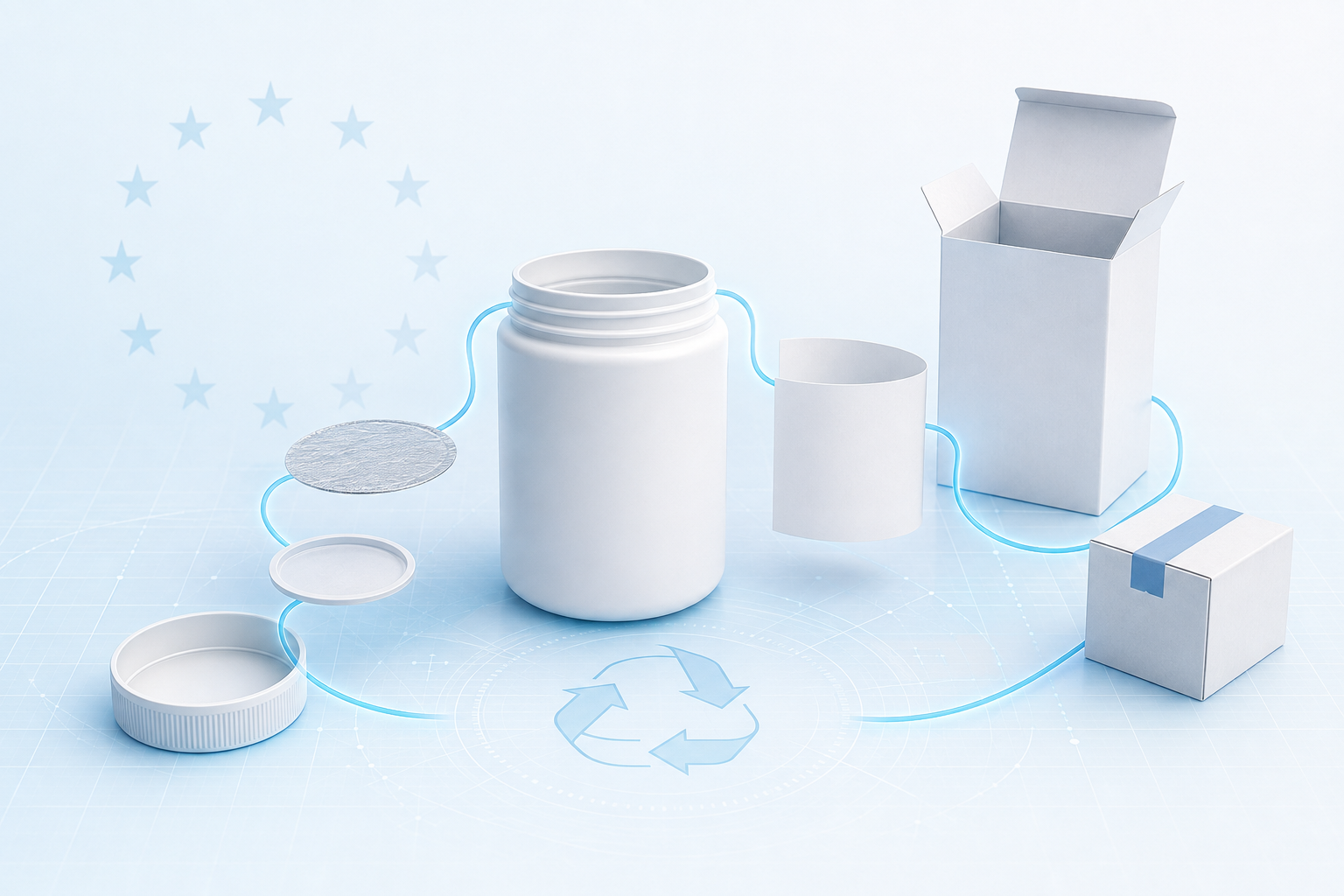
PPWR covers all packaging placed on the EU market, regardless of material or origin. A supplement packaging review may therefore extend beyond the main container to its closure closure, liner, induction seal, label, carton and e-commerce or transport packaging.
One immediate issue is PFAS in food-contact packaging. From 12 August 2026, this packaging cannot be placed on the market at or above the PPWR limits:
- 25 μg/kg, or 25 ppb, for any PFAS measured by targeted analysis;
- 250 μg/kg, or 250 ppb, for the sum of PFAS measured by targeted analysis;
- 50 mg/kg, or 50 ppm, for PFAS, including polymeric PFAS.[1]
The Commission’s 2026 guidance recommends a stepwise analytical approach because no harmonised EU testing method is yet available.[2]
The placing-on-the-market date is important. Food-contact packaging placed on the market before 12 August 2026 may remain available. Packaging placed on the market after that date must comply, even if the empty packaging was produced earlier. There is no general stock-exhaustion period for the PFAS restriction.
For sales and grouped food-contact packaging, the Commission indicates that placing on the market will generally occur after filling because sealing and other final processing steps may affect compliance. Imported packaged products are generally assessed at their release for free circulation in the EU.
Recyclability Applies in 2026, but the Detailed System Comes Later
Article 6 states that all packaging placed on the market must be recyclable. The Commission interprets this general requirement as applying from 12 August 2026.[2]
However, the harmonised design-for-recycling criteria and recyclability performance grades will not apply until 1 January 2030 or 24 months after the relevant delegated act enters into force, whichever is later.
Until then, manufacturers should work with the existing packaging-waste requirements and EN 13430:2004. A supplier’s statement that a container is “recyclable” may support the review, but it does not automatically demonstrate that the complete packaging unit—including closures, seals, labels, inks and adhesives—will meet future PPWR criteria.
New EU Sorting Labels Are Not Required in August 2026
The harmonised material-composition label will apply from 12 August 2028 or 24 months after the relevant implementing act enters into force, whichever is later.[1] Brands should therefore avoid inventing or prematurely applying a “PPWR-compliant” symbol before the official design and rules are final.
Packaging minimisation also follows a staged timetable. The updated requirements addressing unnecessary weight, volume, double walls, false bottoms and avoidable layers apply from 1 January 2030.
The 50% maximum empty-space ratio applies to grouped, transport and e-commerce packaging—not ordinary sales packaging. It will apply from 1 January 2030 or three years after the relevant calculation methodology enters into force, whichever is later.
What Should Supplement Brands Review Now?
Start with a component-level packaging map. Record the material, weight, supplier, function and food-contact status of every component rather than reviewing only the jar or pouch.
Ask suppliers for current specifications, food-contact declarations and available PFAS evidence. A risk-based assessment may be more useful than indiscriminate testing, particularly where packaging contains coatings, barrier layers, grease-resistant papers, recycled inputs or fluorinated materials.
Brands should also confirm who is responsible for the PPWR conformity assessment, technical documentation and EU Declaration of Conformity. From the applicable date, the responsible manufacturer must demonstrate that the packaging meets the relevant requirements before it is placed on the market.
A company selling a packaged product under its own name or trademark may qualify as the manufacturer even when another company physically produces the product or packaging. The exact position should be checked against the PPWR definitions and any applicable exceptions.
The “producer” responsible for registration, reporting and extended producer responsibility is a separate concept. Producer status must be assessed for each Member State, with particular attention to direct cross-border online sales.
Packaging Decisions Should Start with the Product
The smallest pack is not always the most appropriate pack. Daily dose, powder bulk density, flow, moisture sensitivity and serving method can all affect the container size and protective system a supplement requires.
When approving new packaging, brands should reduce avoidable components, favour structures that can be separated and document why each element is necessary. This can lower the risk of another redesign before the detailed 2030 requirements apply.
SRS Nutrition Express can support product developers with ingredient specifications, bulk-density and particle-size information, batch documentation, samples and application discussions. These inputs can help determine dose format, fill volume and packaging requirements before the specification is locked. PPWR conformity and final legal approval remain the responsibility of the relevant economic operator, supported where appropriate by packaging suppliers and qualified compliance advisers.
References
- European Parliament and Council. Regulation (EU) 2025/40 on packaging and packaging waste. EUR-Lex
- European Commission. Guidance document for Regulation (EU) 2025/40 on packaging and packaging waste. Official guidance
Post time: Aug-11-2026


