

Pea protein and whey protein are usually compared for amino acid quality, muscle recovery or vegan positioning. A 2026 randomised crossover trial examined a different question: do they affect blood glucose and insulin differently when consumed with a refined carbohydrate?
The results give product developers a useful lead, but not a finished claim. This was a three-hour glucose-challenge study in healthy adults—not a long-term trial in people with diabetes or a test of ordinary mixed meals.[1]
What Did the Trial Actually Test?
Thirty healthy adults completed five test sessions after an overnight fast. At each session, they consumed one of the following in 250 mL of water:
- 50 g glucose alone;
- 50 g glucose with 10 or 20 g pea protein isolate; or
- 50 g glucose with 10 or 20 g whey protein concentrate.
Blood glucose and plasma insulin were measured for 180 minutes. Because every participant tested all five drinks on separate days, the crossover design reduced some of the person-to-person variation that can complicate nutrition comparisons.[1]
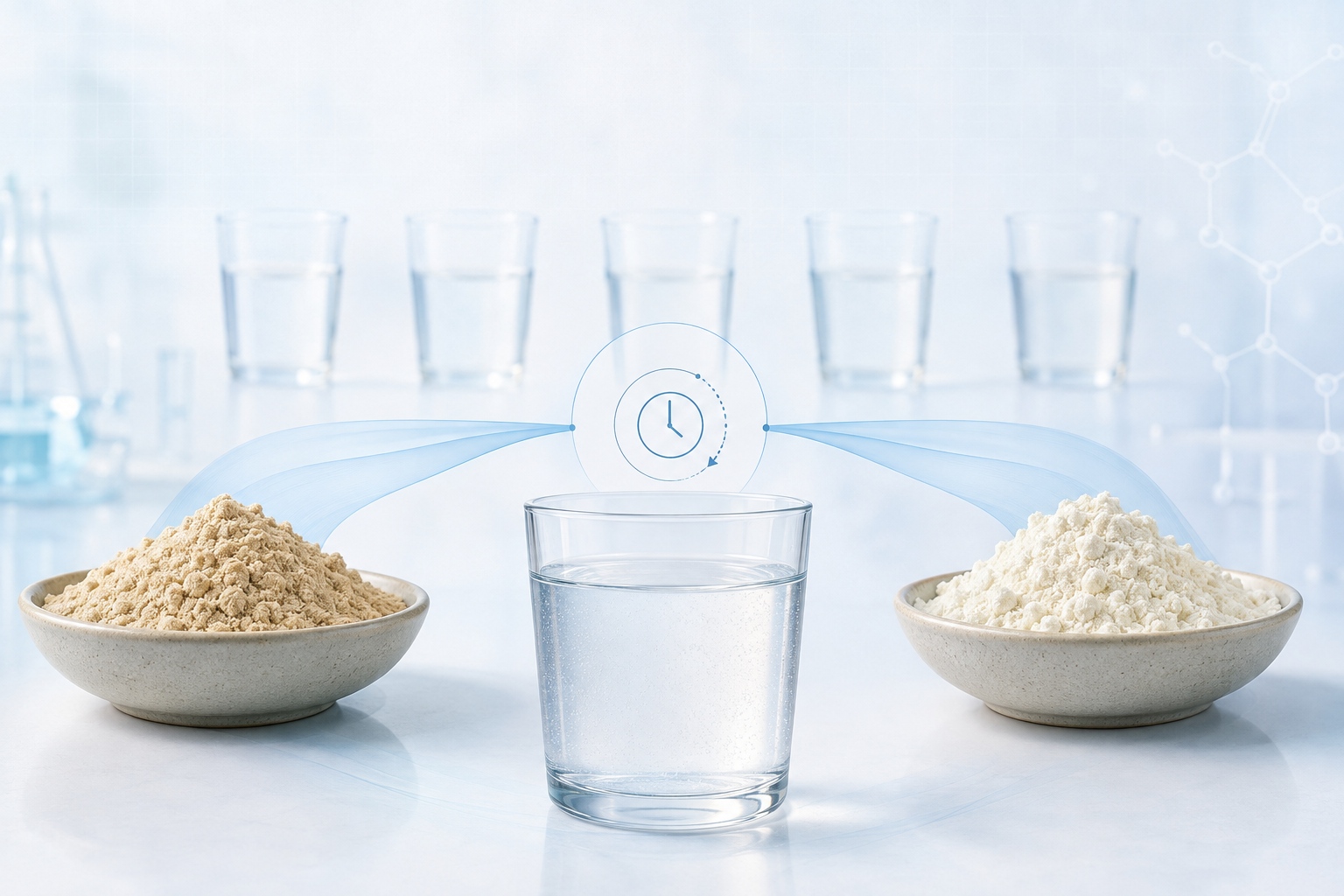
The trial tested one commercial pea protein isolate and one whey protein concentrate. It did not compare every type of pea and whey protein, and the powders were dissolved with glucose rather than incorporated into a bar, shake or complete meal.
Both Proteins Reduced the Glucose Response at 20 g
Compared with glucose alone, adding 20 g of either protein significantly reduced the three-hour incremental area under the blood-glucose curve. The reduction was approximately 37% with pea protein and 30% with whey protein.[1]
At first glance, pea protein appears to perform better. The statistical interpretation is more restrained. The two 20 g treatments were each significantly lower than glucose alone, but the study did not report a significant direct difference between 20 g pea protein and 20 g whey protein for the three-hour glucose iAUC.
The 37% versus 30% result is therefore a numerical difference—not proof that pea protein will consistently reduce post-meal glucose more than whey protein.
Dose also mattered. The clearest glucose reductions occurred at 20 g, while the 10 g results were weaker. This is relevant for products containing only a small amount of protein for front-of-pack positioning.
The Clearer Difference Was the Insulin Response
The clearer direct difference appeared in the insulin results. Over three hours, insulin iAUC was approximately 32% lower with 20 g pea protein than with 20 g whey protein. Peak plasma insulin was also 29% lower, and both differences were statistically significant.[1]
Previous human research has shown that whey can produce a strong insulin response, potentially involving its amino acid profile and incretin hormones.[2,3] The 2026 trial discussed amino acid composition, digestion behaviour and peptides released during digestion as possible explanations for the difference between pea and whey.
However, the researchers did not measure incretin hormones, gastric emptying or digestion kinetics. The study therefore could not establish the mechanism.
A lower acute insulin response should not automatically be labelled “better.” Insulin is part of normal glucose regulation, and this trial did not assess long-term insulin sensitivity, diabetes risk or clinical outcomes.
What Does This Mean for Product Development?
The findings support further investigation of pea protein in carbohydrate-containing shakes, meal replacements, bars and healthy-ageing concepts. They also demonstrate that protein source and serving level can affect metabolic responses—not just the nutrition panel.
The study does not justify marketing a pea protein product as preventing, treating or managing diabetes. Participants were healthy, the intervention was acute and the test drink contained 50 g of glucose without the fat, fibre or food structure found in most meals.
The research was funded by Roquette, supplier of the pea protein tested. Three co-authors were Roquette employees and participated in the study design and decision to publish. The paper states that the funder was not involved in data collection, analysis, interpretation or manuscript preparation.[1] This does not invalidate the findings, but it should be considered when interpreting a single ingredient-specific trial.
Before applying the results commercially, formulators still need to test the finished product. Protein concentration, carbohydrate type, fibre, fat, processing, viscosity and serving size may all influence the response—as well as taste, texture and consumer acceptance.
Choosing Between Pea Protein and Whey Requires a Wider Brief
Post-meal metabolism is one formulation consideration, not the only one. Whey may remain attractive where leucine density, dairy flavour and sports-nutrition familiarity matter. Pea protein can support vegan, dairy-free and differentiated nutrition concepts, but its flavour, texture and amino acid profile must be managed carefully.
SRS Nutrition Express supplies pea and whey protein ingredients and can help brands compare specifications, protein content, dispersibility, sensory fit and supporting documentation before pilot production. The right choice begins with the finished product—not one headline from one trial.
References
- Thondre PS, Young E, Pledger S, et al. A randomized controlled trial in healthy participants to compare the insulinogenic effects of whey protein and pea protein co-ingested with glucose. PLOS ONE. 2026;21(1):e0340386. https://doi.org/10.1371/journal.pone.0340386
- Nilsson M, Stenberg M, Frid AH, Holst JJ, Björck IME. Glycemia and insulinemia in healthy subjects after lactose-equivalent meals of milk and other food proteins: the role of plasma amino acids and incretins. American Journal of Clinical Nutrition. 2004;80(5):1246–1253. https://doi.org/10.1093/ajcn/80.5.1246
- Wolever TMS, et al. The effect of adding protein to a carbohydrate meal on postprandial glucose and insulin responses: a systematic review and meta-analysis. 2024. PubMed record
Post time: Aug-12-2026


