

Peru’s 2026 anchoveta fishing season is a useful reminder that a large official quota does not automatically create immediately available fishmeal and fish oil.
On April 1, 2026, Peru announced a total allowable catch of 1,914,049 metric tons for the first North-Central anchoveta season. On paper, this appeared to support a healthy supply outlook.
The physical market has been more complicated.
Warm-water conditions, a high incidence of juvenile fish and precautionary fishery-management measures led to temporary closures during April and May. On June 11, fishing activity across the North-Central zone was suspended, with future reopening dependent on scientific evaluation.
For omega-3 brands, refiners, contract manufacturers and aquaculture feed producers, the key issue is therefore not only how much quota has been announced.
The more practical question is how much qualified material has actually been landed, processed and made available for shipment.

Why Peru Matters to the Marine Ingredients Market
Peru is one of the world’s most important origins for fishmeal and fish oil.
When anchoveta fishing slows, processing plants receive less raw material. Production becomes less predictable, prompt export availability may tighten and suppliers may become less willing to discount existing inventory.
The effect can be especially important for buyers with strict specifications.
Fishmeal customers may require defined protein levels, digestibility, freshness and drying methods. Fish oil buyers may need specific oxidation limits, EPA and DHA profiles, contaminant controls and traceability documentation.
The market may therefore have material available in general terms while still lacking the exact grade a buyer needs.
Why Quota Does Not Equal Supply
A quota establishes the maximum legal catch. It does not guarantee that the full amount will be harvested, processed or exported.
The supply chain includes several separate stages:
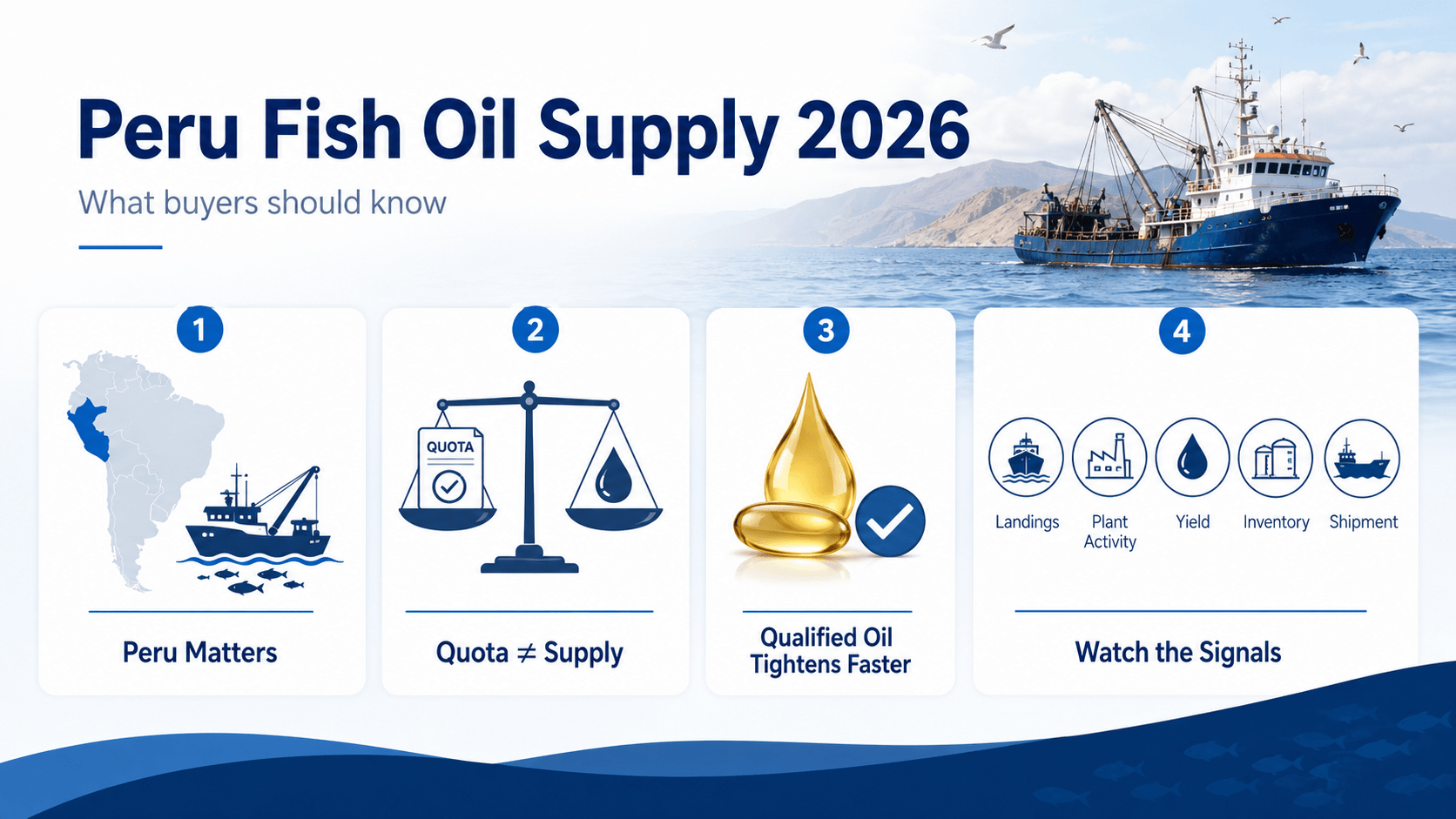
Authorized quota → actual catch → landed fish → processed output → qualified inventory → shipment
A disruption at any stage can reduce effective supply.
Temporary closures may force vessels to move to other areas, reduce catch rates or interrupt plant operations. Fish oil yield can also vary according to the size, biological condition and fat content of the anchoveta.
In addition, part of the newly produced material may already be allocated under earlier contracts.
This means buyers should not rely only on the percentage of quota completed when evaluating availability.
Why Fish Oil Can Tighten Faster Than Expected
Fish oil and fishmeal come from the same raw-material chain, but their markets are different.
Fishmeal is mainly used in aquaculture and animal nutrition. Fish oil is used in aquaculture, human nutrition and pharmaceutical products.
Not every crude oil batch is suitable for refining, concentration, deodorization or encapsulation. A buyer may be told that fish oil is available, but the offered material may not meet the required peroxide value, anisidine value, TOTOX, contaminant limits or fatty-acid profile.
The real pressure is therefore not only on total tonnage. It is also on qualified oil that can perform reliably in higher-value applications.
What Buyers Should Monitor
The next direction of fish oil supply in 2026 will depend on operational data rather than general market commentary.
Buyers should monitor:
the duration and geographic scope of fishing restrictions;
juvenile incidence in reported catches;
cumulative landings against the quota;
plant operating rates;
fish oil production yields;
producer and port inventories; and
confirmed shipment schedules.
A reopening decision will not immediately create export-ready material. The fish must still be caught, processed, tested and released.
The current situation does not mean every buyer should stockpile.
It does mean procurement teams need better visibility into where their material is, whether it meets specification and when it can realistically arrive.
In a volatile marine-ingredient market, that visibility is often more useful than another short-term price prediction.
AUTHOR
SRS Nutrition Express
REVIEWED BY
SRS Sourcing and Technical Team
LAST SUBSTANTIVE REVIEW
June 2026
Post time: Jun-26-2026


